


Description
-
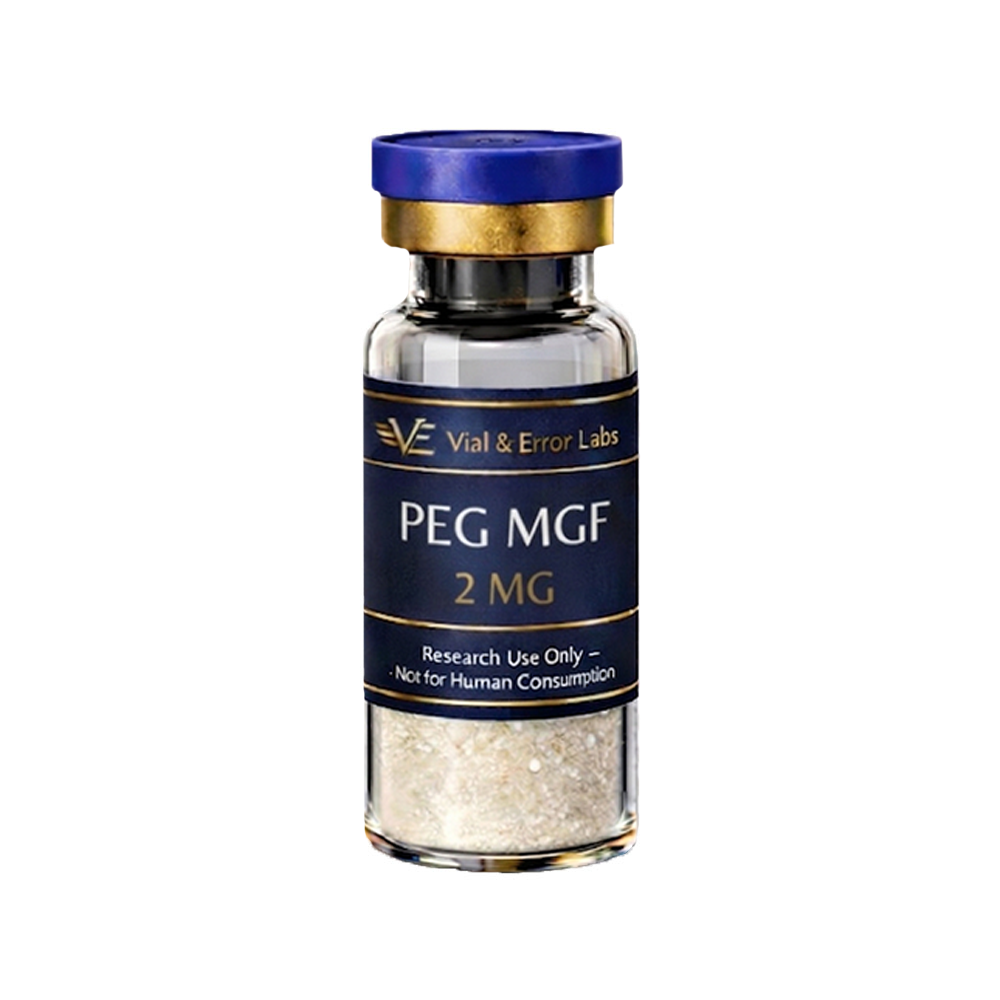
About PEG MGF
Oxytocin Acetate (CAS 6233-83-6) is the acetate salt of synthetic PEG MGF (PEGylated Mechano Growth Factor) is a synthetic polyethylene glycol (PEG) conjugate of the MGF peptide — an IGF-1 splice variant generated in response to mechanical loading or tissue damage — with PEGylation providing dramatically extended serum half-life compared to unmodified MGF. The PEG conjugation results in an overall molecular weight of ~4,000–5,000 g/mol depending on PEG chain length. It is supplied as a laboratory-grade lyophilized powder intended strictly for analytical and non-clinical research applications.
Unmodified MGF has a very short half-life in biological systems (~minutes) due to rapid serum protease degradation, limiting its utility in studies requiring sustained receptor engagement. PEGylation masks protease cleavage sites and reduces renal clearance, extending functional half-life to hours-to-days and making PEG MGF the preferred form for time-course tissue repair studies, pharmacokinetic modeling, and any in vitro/in vivo protocol requiring extended IGF-1 splice variant signaling. Researchers use PEG MGF in C2C12, primary satellite cell, cardiomyocyte, and bone marrow stromal cell models to study satellite cell activation pathway mapping over extended time courses, PI3K/Akt/mTOR mechanotransduction signaling, and IGF-1 splice variant pharmacokinetic characterization.
COMMON RESEARCH APPLICATIONS
Sustained Satellite Cell Activation & Repair Kinetics
PEG MGF is used in primary satellite cell and C2C12 models in time-course studies (24–96 h) where the short half-life of unmodified MGF is prohibitive. Used to study prolonged Pax7/MyoD expression, sustained IGF-1 splice variant signaling, and satellite cell differentiation kinetics.In Vivo Pharmacokinetic Modeling
PEGylation extends MGF half-life from minutes to hours-to-days, enabling preclinical PK studies in rodent muscle injury models; used to characterize plasma concentration-time profiles, tissue distribution, and systemic vs. local IGF-1 splice variant signaling duration.Cardiac & Skeletal Muscle Repair Pathway Studies
Used in cardiomyocyte (H9c2, NRVM) and skeletal muscle (C2C12, L6) models to study PI3K/Akt/mTOR pathway activation under sustained MGF receptor engagement; used in ischemia/reperfusion injury models to characterize myocardial repair signaling endpoints.Comparative MGF / PEG MGF Benchmarking
Paired with unmodified MGF in parallel dose-response and time-course assays to directly quantify the effect of PEGylation on half-life extension, receptor engagement duration, satellite cell activation magnitude, and downstream PI3K/mTOR signaling amplitude. -
Chemical Identity
Compound Name: PEG MGF
Internal Catalog Code: PEG MGF
CAS Number: N/A
Molecular Formula: PEGylated MGF peptide
Molecular Weight: ~4,000-5,000 g/mol
Physical Properties
Form/Appearance: Lyophilized powder
Quality & Testing
Purity: As listed on lot-specific COA
Testing Method : HPLC (as applicable) · identity confirmation per COA
Verification
COA: Lot-specific, included with order (QR on label)
Handling & Storage
Storage Temperature: Store desiccated at −20°C for long-term; 2–8°C short-term. Protect from light. Refer to SDS/COA for compound-specific handling.
Light Sensitivity: Protect from light
Moisture: Store desiccated when applicable
Available Strengths: 2 mg
SKU (2 mg): VE-PEGM-002
-
-
What is this product?
PEG MGF (PEGylated Mechano Growth Factor, MW ~4,000–5,000 g/mol) is supplied as a lyophilized PEG-conjugated IGF-1 splice variant peptide for laboratory research use only. It is the extended-half-life form of MGF for time-course and pharmacokinetic studies. Available as VE-PEGM-002 (2 mg).
-
What purity and testing methods are used?
Each lot is tested by reverse-phase HPLC and MS confirmation for peptide identity, with PEG conjugation degree verification. A lot-specific COA documenting peptide identity, PEG conjugation, and purity is included with every order, accessible via QR code on the label.
-
What are the key chemical identifiers?
No registered CAS number (PEGylated peptide conjugate) · MW ~4,000–5,000 g/mol (PEG chain dependent) · Core peptide: MGF (24-aa IGF-1 Ec splice variant) · Synonyms: PEGylated MGF, PEG-Mechano Growth Factor, long-acting MGF.
-
How does PEG MGF differ from standard MGF in research use?
Unmodified MGF has a half-life of ~minutes in serum due to rapid protease degradation — it is used for acute local signaling studies where short signal pulse is desirable. PEG MGF has a half-life of hours-to-days depending on PEG chain length, enabling sustained receptor engagement studies, time-course satellite cell activation experiments, and in vivo pharmacokinetic studies that are impractical with unmodified MGF.
-
What is the recommended storage upon receipt?
Store immediately at −20°C desiccated. Short-term at 2–8°C acceptable. Inspect vials for integrity upon receipt. Review the COA to confirm PEG conjugation degree for the specific lot.
-
What is a COA and why does it matter?
A COA documents lot-specific peptide identity (MS), PEG conjugation degree, and purity. For PEGylated peptides, the degree of PEGylation directly affects half-life and receptor interaction — this must be verified lot-to-lot. Each lot ships with a QR-accessible COA. Review before use.
-
What is this product?
Reviews
There are no reviews yet.