


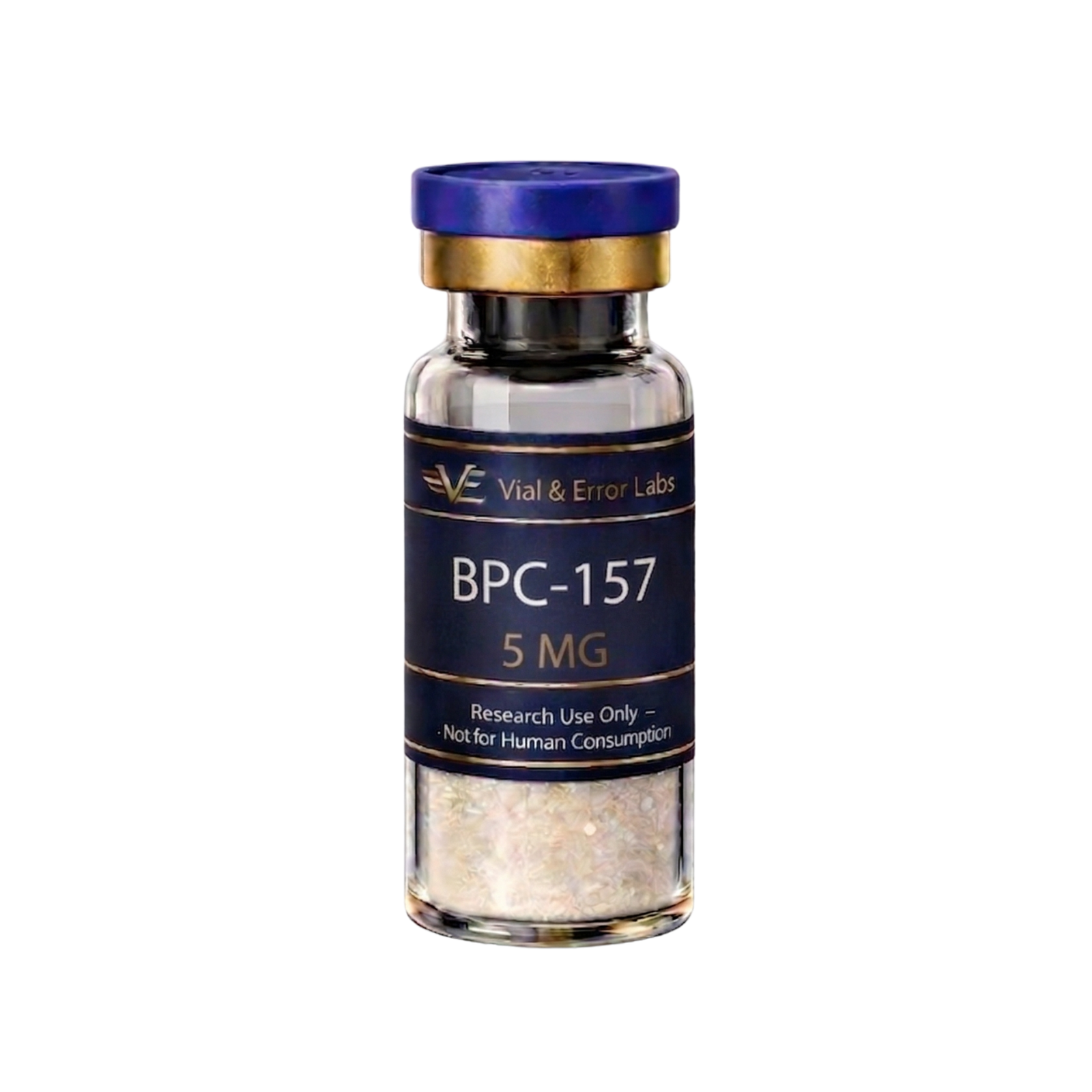
Description
-
About BPC-157 (Body Protection Compound-157)
BPC-157 — Body Protection Compound-157 (CAS 1628202-19-6) — is a synthetic 15-amino acid pentadecapeptide derived from a conserved sequence of human gastric juice protein. It is one of the most widely studied stable gastric peptides in preclinical models of tissue repair, angiogenesis, and gut-brain axis signaling. Unlike many peptides, BPC-157 is resistant to enzymatic degradation in gastric acid, making it a stable research tool across multiple biological matrices.
It has been studied in models examining nitric oxide (NO) synthesis, growth hormone receptor modulation, and FAK/paxillin signaling in fibroblast and endothelial cell models. Supplied as lyophilized peptide for analytical and non-clinical research applications only.
COMMON RESEARCH APPLICATIONS
Tissue Repair Signaling Models
BPC-157 modulates fibroblast migration and proliferation via FAK/paxillin pathway activation. Used in wound healing models (scratch assays, collagen contraction) to study growth factor-independent tissue repair signaling in HUVEC and dermal fibroblast lines.Angiogenesis Research
Promotes VEGFR2 expression and tube formation in endothelial cell models. Used to study NO-dependent angiogenic signaling and capillary network formation in vitro alongside VEGF as a reference comparator.Gastrointestinal Protective Signaling
Studied in GI epithelial models for mucosal cytoprotection pathways; used alongside indomethacin-injury models and cytokine challenge to examine protective signaling in Caco-2 cells.Tendon & Musculoskeletal Research
Used in preclinical models examining tenocyte proliferation, collagen synthesis, and Achilles tendon repair signaling; often studied alongside TB-500 in combined matrix remodeling experiments. -
Chemical Identity
Compound Name: BPC-157
Synonyms: Body Protection Compound-157 · Bepecin · PL 14736 · pentadecapeptide BPC-157 · Gly-Glu-Pro-Pro-Pro-Gly-Lys-Pro-Ala-Asp-Asp-Ala-Gly-Leu-Val
CAS Number: 1628202-19-6
EC Number: N/A (synthetic peptide)
Molecular Formula: C₆₂H₉₈N₁₆O₂₂ · XC₂H₄O₂
Molecular Weight: 1419.50 g/mol (free base)
Physical Properties
Appearance: White to off-white lyophilized powder
Solubility (water): ~1 mg/mL in sterile water or PBS (pH 7.4)
Solubility (organic): Limited; DMSO (~1 mg/mL with warming)
Hygroscopic: Yes — store desiccated
Quality & Testing
Purity: ≥98% (HPLC)
Testing Method : Reverse-phase HPLC · MS confirmation · sequence verification
Verification
COA: Lot-specific, included with order (QR on label)
SDS Supplier : See SDS/MSDS · OSHA HCS / GHS compliant
Handling & Storage
Storage Temperature: Store desiccated at −20°C long-term; 2–8°C short-term. Protect from light. Refer to SDS/COA for compound-specific handling.
Light Sensitivity: Protect from light
Reconstitution: Dissolve in sterile water or PBS (pH 7.4); use immediately or aliquot and store at −80°C
Available Strengths: 5 mg · 10 mg
SKU (5 mg): VE-BPC157-005
SKU (10 mg): VE-BPC157-010
-
-
What is this product?
BPC-157 is supplied as a lyophilized 15-amino acid pentadecapeptide (CAS 1628202-19-6, MW 1419.50 g/mol) intended for laboratory research use only. Also known as Body Protection Compound-157 (Bepecin).
-
What purity and testing methods are used?
Each lot is tested by reverse-phase HPLC and MS confirmation to ≥98% purity with sequence verification. A lot-specific COA is included with every order, accessible via QR code on the label.
-
What are the key chemical identifiers?
CAS 1628202-19-6 · Molecular formula C₆₂H₉₈N₁₆O₂₂ · MW 1419.50 g/mol · Synonyms: Body Protection Compound-157, Bepecin, PL 14736, pentadecapeptide BPC.
-
How is BPC-157 reconstituted for research use?
Dissolve in sterile water or PBS (pH 7.4) at ~1 mg/mL. Use immediately after reconstitution or aliquot and store at −80°C to prevent degradation. Avoid repeated freeze-thaw cycles. Protect from light.
-
What signaling pathways does BPC-157 affect in research models?
BPC-157 has been studied for effects on FAK/paxillin signaling in fibroblasts, VEGFR2-mediated angiogenesis in endothelial cells, and nitric oxide (NO) synthase modulation. It is also studied for growth hormone receptor pathway interactions in preclinical models.
-
What is the recommended storage upon receipt?
Store immediately at −20°C in a desiccated environment. For long-term stability, −80°C is preferred. Short-term at 2–8°C is acceptable. Inspect vials for integrity upon receipt.
-
What is a COA and why does it matter?
A COA documents lot-specific results including purity (HPLC ≥98%), sequence verification (MS), and appearance. Each lot ships with a QR-accessible COA. Review before use to confirm identity and purity meet your experimental requirements.
-
What is this product?
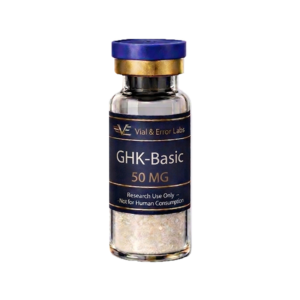
Reviews
There are no reviews yet.