


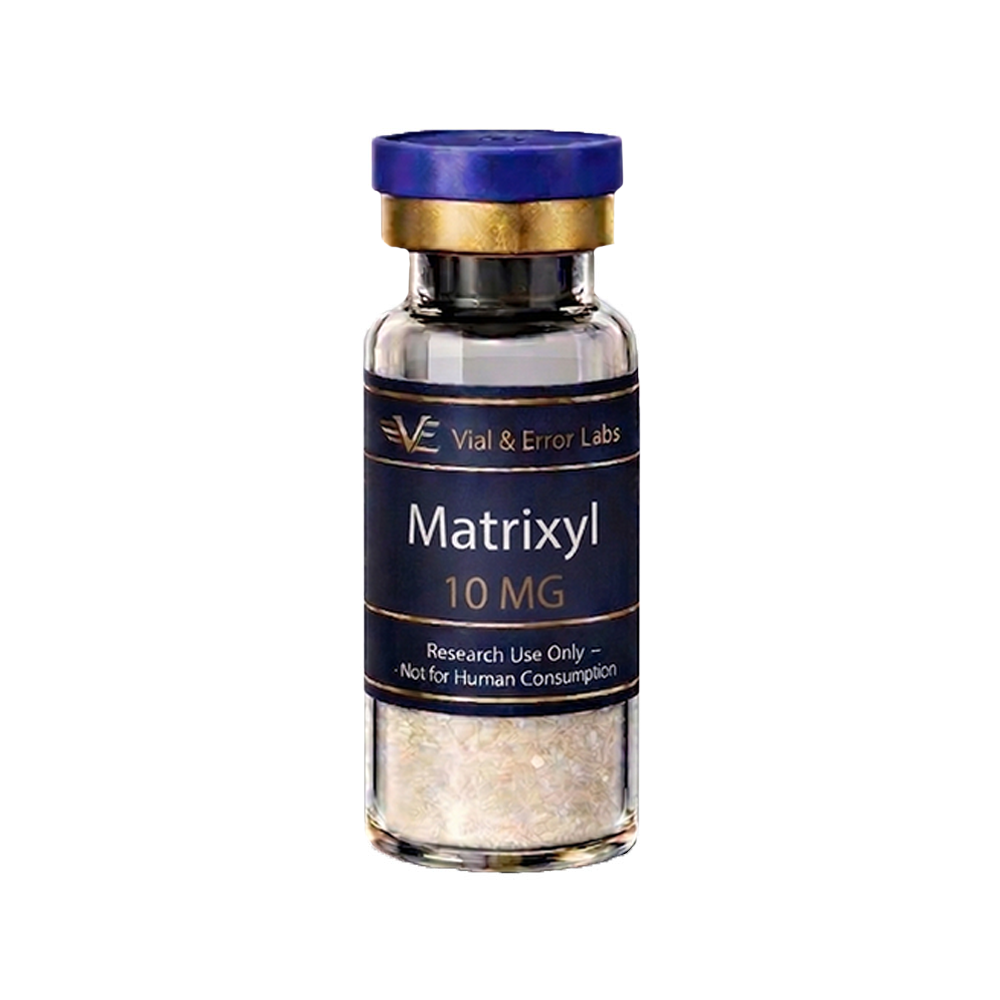
Description
-
About Matrixyl
Matrixyl (Palmitoyl Pentapeptide-4, CAS 214047-00-4) is a synthetic lipopeptide consisting of a palmitoyl (C16) fatty acid chain conjugated to the Lys-Thr-Thr-Lys-Ser pentapeptide sequence via an amide bond. It is one of the most widely studied cosmetic peptide tool compounds in skin biology and extracellular matrix (ECM) research. It is supplied as a laboratory-grade material intended strictly for analytical and non-clinical research applications.
Matrixyl was designed to mimic the C-terminal sequence of type I collagen, acting as a "messenger" that signals dermal fibroblasts to upregulate collagen and ECM component synthesis. It has been shown to stimulate type I and type IV collagen, fibronectin, and hyaluronic acid production in fibroblast models. The palmitoyl chain confers lipophilicity enabling membrane interaction and uptake. Researchers use Matrixyl in human dermal fibroblast (HDFa), HaCaT keratinocyte, and 3D skin equivalent models to study collagen I/III/IV biosynthesis pathway activation, MMP-mediated ECM turnover balance, TGF-β/SMAD2/3 collagen signaling, and peptide-biomaterial interaction in dermal repair assay development.
COMMON RESEARCH APPLICATIONS
Collagen Biosynthesis Gene Expression Studies
Matrixyl is examined in HDFa and CCD-1079Sk dermal fibroblast models to study COL1A1, COL1A2, and COL4A1 gene upregulation, procollagen type I C-peptide (PICP) secretion, and TGF-β/SMAD2/3-independent collagen synthesis pathway activation.ECM Remodeling & MMP Balance Assays
Used in 3D collagen gel and skin equivalent models to characterize fibronectin and decorin expression, MMP-1/MMP-3 ECM turnover modulation, and TIMP-1/TIMP-2 balance as markers of net collagen remodeling under Matrixyl treatment conditions.Lipopeptide Membrane Interaction & Delivery Studies
Used in membrane partitioning, liposome uptake, and confocal internalization assays to study palmitoyl-peptide membrane interaction, cellular uptake kinetics, and delivery efficiency as a function of lipid chain length compared to non-lipidated Lys-Thr-Thr-Lys-Ser.Comparative Cosmetic Peptide Benchmarking
Reference standard in anti-aging peptide screening panels alongside Matrixyl 3000 (Pal-GHK/Pal-GQPR combination), Argireline (Ac-Glu-Glu-Met-Gln-Arg-Arg-NH₂), and Leuphasyl to characterize collagen-stimulating potency, mechanism, and dose-response profiles. -
Chemical Identity
Compound Name: Matrixyl
Internal Catalog Code: Matrixyl
CAS Number: 214047-00-4
Molecular Formula: C34H54N6O8
Molecular Weight: 678.84 g/mol
Physical Properties
Form/Appearance: Lyophilized powder
Quality & Testing
Purity: As listed on lot-specific COA
Testing Method : HPLC (as applicable) · identity confirmation per COA
Verification
COA: Lot-specific, included with order (QR on label)
Handling & Storage
Storage Temperature: Store desiccated at −20°C for long-term; 2–8°C short-term. Protect from light. Refer to SDS/COA for compound-specific handling.
Light Sensitivity: Protect from light
Moisture: Store desiccated when applicable
Available Strengths: 10 mg
SKU (10 mg): VE-MATR-010
-
-
What is this product?
Matrixyl (Palmitoyl Pentapeptide-4, CAS 214047-00-4, MW 678.84 g/mol, C₃₄H₅₄N₆O₈) is supplied as a lyophilized synthetic lipopeptide for laboratory research use only. It is the reference compound for collagen-stimulating peptide research in skin ECM biology. Available as VE-MATR-010 (10 mg).
-
What purity and testing methods are used?
Each lot is tested by reverse-phase HPLC and MS confirmation with sequence and lipid-conjugation verification. A lot-specific COA is included with every order, accessible via QR code on the label.
-
What are the key chemical identifiers?
CAS 214047-00-4 · Molecular formula C₃₄H₅₄N₆O₈ · MW 678.84 g/mol · Sequence: Palmitoyl-Lys-Thr-Thr-Lys-Ser · Synonyms: Palmitoyl Pentapeptide-4, Palmitoyl Pentapeptide-3, Matrixyl (INCI name), Pal-KTTKS.
-
How is Matrixyl reconstituted for research use?
Dissolve in sterile water or PBS at ~1–5 mg/mL with warming (the palmitoyl chain reduces aqueous solubility). Alternatively, dissolve in ethanol at ~10 mg/mL and dilute into aqueous buffer. Use immediately or store aliquots at −20°C. Protect from light.
-
What is the recommended storage upon receipt?
Store at −20°C desiccated. Short-term at 2–8°C acceptable. The palmitoyl chain is susceptible to hydrolysis under warm/moist conditions — keep desiccated and cold. Inspect vials for integrity upon receipt.
-
What is a COA and why does it matter?
A COA documents lot-specific purity (HPLC), MS identity, and lipid-conjugation integrity verification. For Matrixyl, confirming the palmitoyl-peptide bond is intact is essential for biological activity in collagen stimulation assays. Each lot ships with a QR-accessible COA. Review before use.
-
What is this product?
Reviews
There are no reviews yet.