

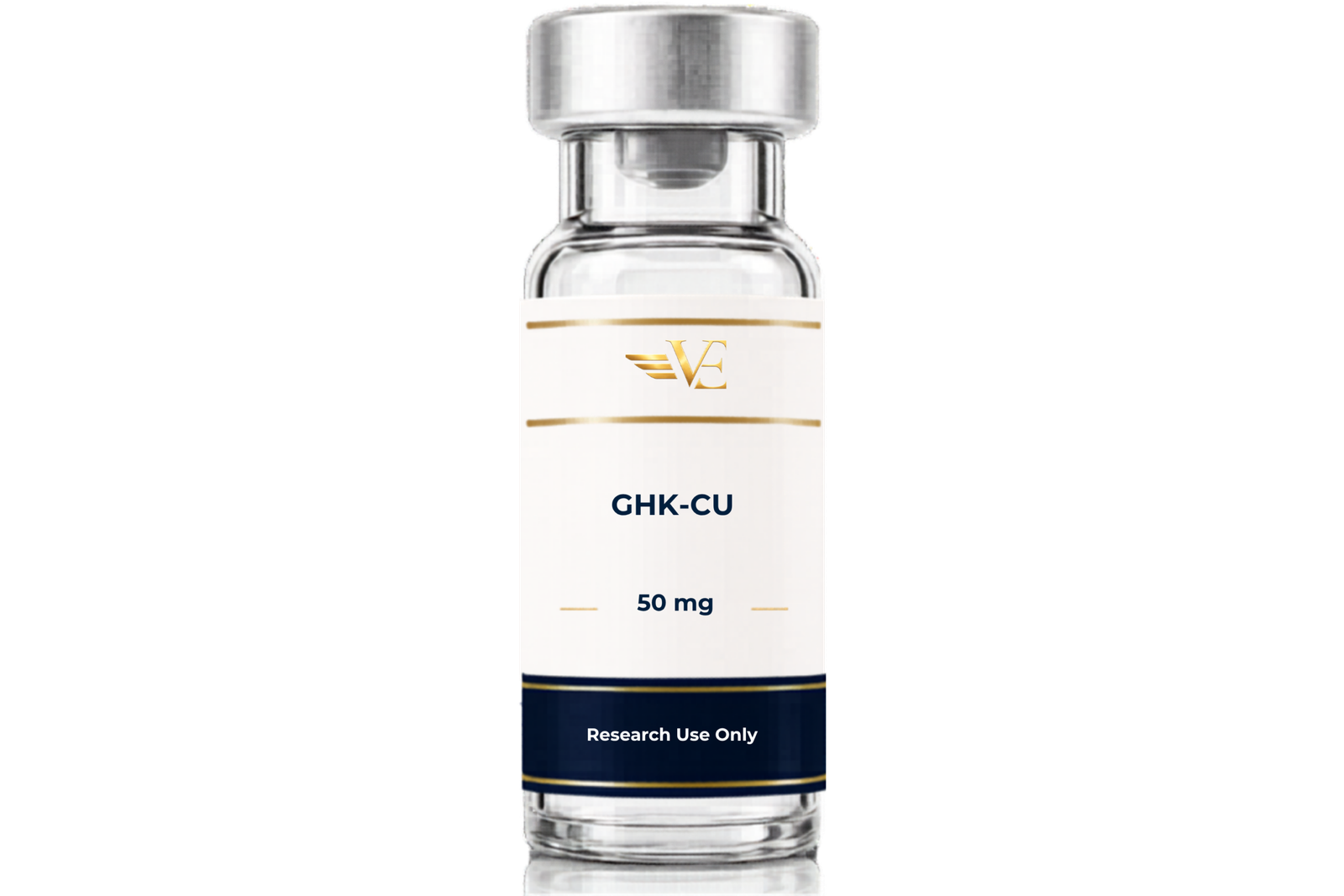
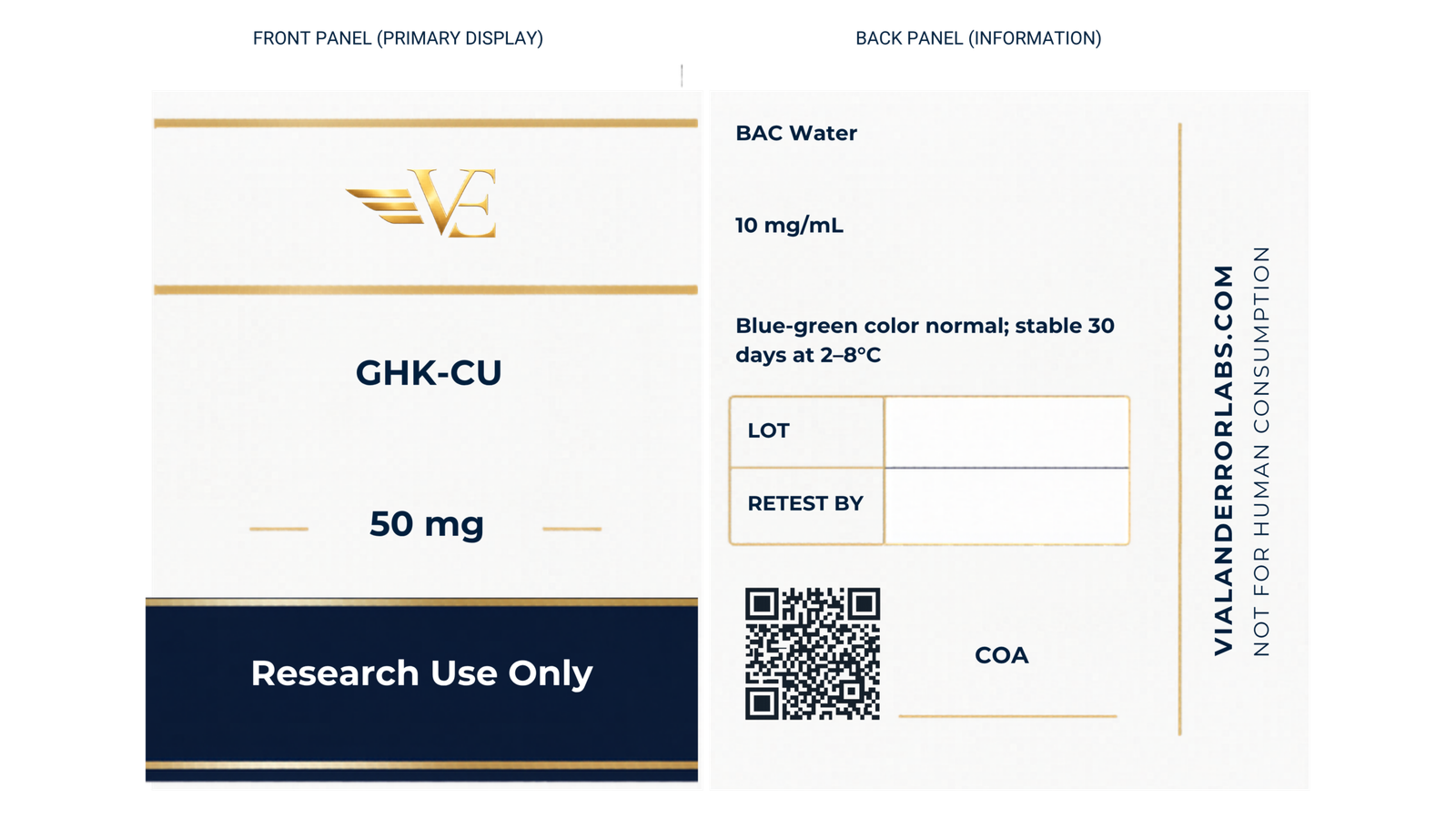
Description
-
About GHK-Cu (Copper Peptide GHK-Cu)
GHK-Cu — glycyl-L-histidyl-L-lysine copper(II) complex (CAS 89030-95-5) — is a naturally occurring plasma tripeptide that forms a stable complex with copper(II) ions. It is one of the most studied peptide-metal complexes for wound healing, collagen remodeling, and skin biology research. Endogenous GHK-Cu levels decline sharply with age (from ~200 ng/mL in young adults to ~80 ng/mL in older adults), making it a well-characterized age-associated biomarker in aging biology research.
GHK-Cu activates a broad range of wound healing and anti-inflammatory genes via interaction with DNA-binding proteins and has been shown to upregulate collagen, fibronectin, and decorin synthesis in fibroblast models. Supplied as lyophilized powder for analytical and non-clinical research use only.
COMMON RESEARCH APPLICATIONS
Collagen Synthesis & Remodeling
GHK-Cu stimulates collagen type I and III synthesis and upregulates MMP-2 in dermal fibroblast models. Used in collagen gel contraction assays and gene expression studies examining TGF-β-independent collagen remodeling pathways.Wound Healing Pathway Research
Activates wound response genes including fibronectin, decorin, and osteopontin. Used in scratch assay and 3D skin equivalent models to study growth factor-like signaling without receptor tyrosine kinase activation.Anti-Inflammatory Gene Expression
Suppresses TNF-α, IL-6, and IL-1β expression in macrophage models. Used to study NF-κB pathway modulation and anti-oxidant gene upregulation (SOD, catalase) in inflammatory challenge models.Aging Biology & Senescence Research
Used as an age-associated peptide marker in cell aging models; studied for effects on p53/p63 signaling, telomere maintenance, and DNA repair gene upregulation in senescent fibroblasts. -
Chemical Identity
Compound Name: GHK-Cu
Synonyms: Copper peptide GHK · GHK-copper · glycyl-l-histidyl-l-lysine copper(II) · Lamin · Iamin
CAS Number: 49557-75-7 (GHK free base); 89030-95-5 (GHK-Cu complex)
EC Number: N/A (peptide-metal complex)
Molecular Formula: C₁₄H₂₃CuN₆O₄
Molecular Weight: 462.00 g/mol
Physical Properties
Appearance: Blue to blue-green lyophilized powder
Solubility (water): ≥10 mg/mL in sterile water (pH 6–7)
Solubility (organic): Limited in ethanol; insoluble in DMSO
Hygroscopic: Yes — store desiccated
Quality & Testing
Purity: ≥98% (HPLC)
Testing Method : Reverse-phase HPLC · ICP-MS copper content verification · sequence confirmation
Verification
COA: Lot-specific, included with order (QR on label)
SDS Supplier : See SDS/MSDS · OSHA HCS / GHS compliant
Handling & Storage
Storage Temperature: Store desiccated at −20°C long-term; 2–8°C short-term. Protect from light. Refer to SDS/COA for compound-specific handling.
Light Sensitivity: Protect from light
Reconstitution: Dissolve in sterile water at ≥10 mg/mL; stable at neutral pH; precipitates at alkaline pH
Available Strengths: 50 mg · 100 mg
SKU (50 mg): VE-GHKCU-050
SKU (100 mg): VE-GHKCU-100
-
-
What is this product?
GHK-Cu is supplied as a lyophilized copper peptide complex (CAS 89030-95-5, MW 462.00 g/mol) intended for laboratory research use only. It is a naturally occurring tripeptide-copper(II) complex found in human plasma, urine, and saliva.
-
What purity and testing methods are used?
Each lot is tested by reverse-phase HPLC to ≥98% purity with ICP-MS copper content verification and sequence confirmation. A lot-specific COA is included with every order, accessible via QR code on the label.
-
What are the key chemical identifiers?
CAS 89030-95-5 (GHK-Cu complex); 49557-75-7 (GHK free peptide) · Molecular formula C₁₄H₂₃CuN₆O₄ · MW 462.00 g/mol · Synonyms: copper peptide GHK, glycyl-l-histidyl-l-lysine copper(II), Lamin.
-
What research pathways does GHK-Cu affect?
GHK-Cu has been studied for upregulation of collagen I/III, fibronectin, and decorin in fibroblasts; TNF-α/IL-6 suppression in macrophage models; and activation of SOD and catalase antioxidant pathways. It also interacts with DNA-binding proteins involved in wound response gene networks.
-
What is the recommended storage upon receipt?
Store immediately at −20°C desiccated. The copper complex is sensitive to moisture and light. Short-term at 2–8°C is acceptable. Inspect vials for color integrity (should be blue to blue-green) upon receipt.
-
What is a COA and why does it matter?
A COA documents lot-specific purity (HPLC ≥98%), copper content (ICP-MS), sequence confirmation, and appearance. Each lot ships with a QR-accessible COA. Review before use to confirm identity, purity, and copper stoichiometry meet your experimental requirements.
-
What is this product?
-
PubMed Literature Search — GHK-Cu
Primary literature · 400+ indexed studies
Open PubMedPubChem Compound Record
CAS 300801-03-0 · Full chemical data, bioassays, patents
View RecordSupplier Product Insert / Technical Data Sheet
Solubility data, copper content verification, storage protocol
Download PDF