


Description
-
About MGF
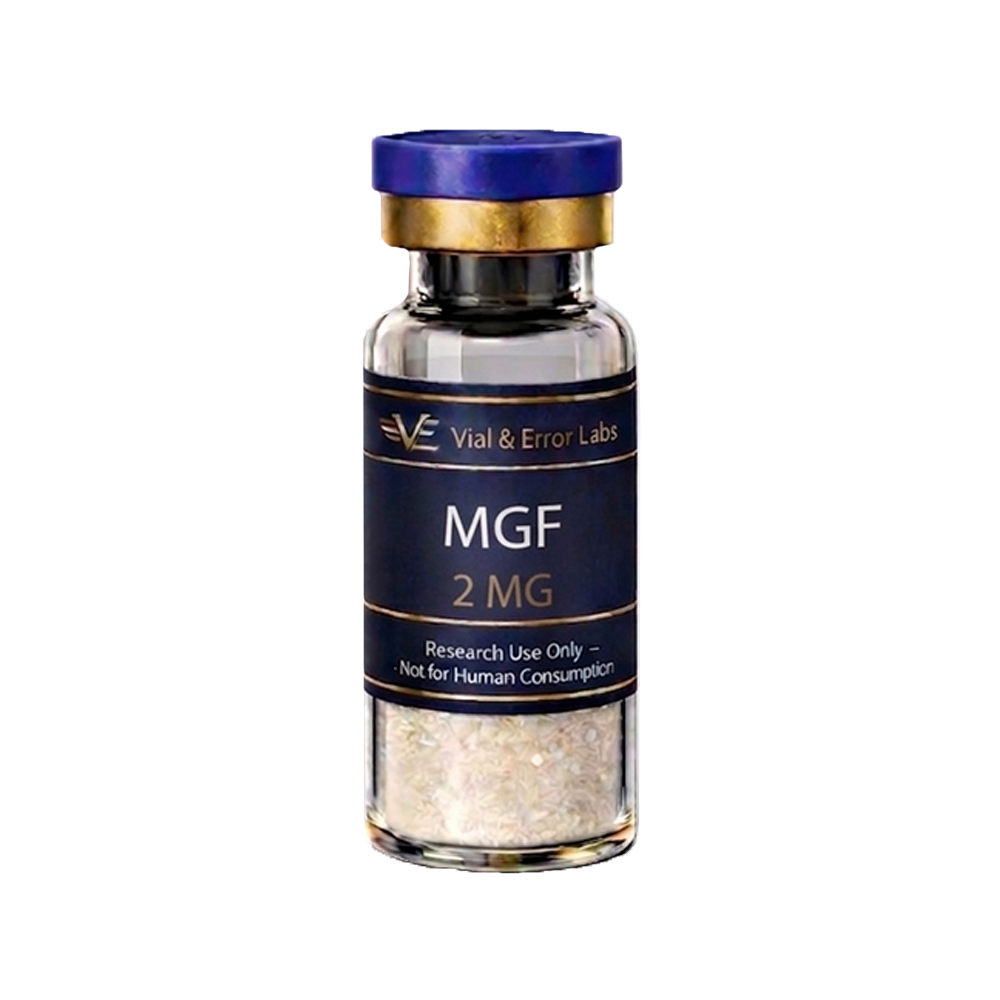
MGF (Mechano Growth Factor, CAS 172434-12-7) is a 24-amino acid splice variant of IGF-1 generated by alternative splicing of the IGF-1 gene specifically in response to mechanical loading or tissue damage in muscle, bone, and cardiac tissue. It is supplied as a laboratory-grade lyophilized powder intended strictly for analytical and non-clinical research applications.
Unlike systemic IGF-1 (which primarily signals through the IGF-1 receptor/PI3K/Akt axis), MGF functions as a local tissue-repair signal that activates satellite cell proliferation and inhibits myoblast differentiation — allowing muscle progenitor cells to expand before committing to differentiation. The distinctive C-terminal E-domain peptide of MGF (the "MGF E-domain" or "MGF C-terminal peptide") is responsible for this IGF-1R-independent satellite cell activation. MGF is studied in C2C12, primary satellite cell, and cardiomyocyte models to investigate mechanotransduction pathways, satellite cell activation signaling (Notch/Pax7), PI3K/Akt/mTOR pathway modulation versus IGF-1, and cardiac repair pathway markers under standardized in vitro conditions.
COMMON RESEARCH APPLICATIONS
Satellite Cell Activation & Muscle Regeneration Research
MGF is examined in primary satellite cell and C2C12 myoblast models under mechanical stretch or injury simulation to study MGF E-domain-mediated satellite cell proliferation, Pax7/MyoD expression, and IGF-1R-independent activation pathway mapping.Mechanotransduction Signaling Studies
Used in stretch-activated cell models and bioreactor systems to characterize PI3K/Akt/mTOR pathway modulation, focal adhesion kinase (FAK) activation, and mechanosensitive gene expression (MMP-2, collagen IV) downstream of MGF receptor engagement.Acute vs. Sustained Signaling Kinetics
MGF s short serum half-life (~minutes) makes it the tool of choice for acute signal pulse studies in satellite cell models. Used in time-course proliferation assays alongside PEG MGF to characterize the temporal dynamics of IGF-1 splice variant signaling.Comparative IGF-1 Splice Variant Benchmarking
Benchmarked against systemic IGF-1, IGF-2, and PEG MGF in satellite cell activation and myoblast proliferation assays to characterize receptor-independent (E-domain) vs. IGF-1R-dependent signaling contributions and half-life vs. potency trade-offs. -
Chemical Identity
Compound Name: MGF
Internal Catalog Code: MGF
CAS Number: 172434-12-7
Molecular Formula: C121H200N42O39
Molecular Weight: 2867.18 g/mol
Physical Properties
Form/Appearance: Lyophilized powder
Quality & Testing
Purity: As listed on lot-specific COA
Testing Method : HPLC (as applicable) · identity confirmation per COA
Verification
COA: Lot-specific, included with order (QR on label)
Handling & Storage
Storage Temperature: Store desiccated at −20°C for long-term; 2–8°C short-term. Protect from light. Refer to SDS/COA for compound-specific handling.
Light Sensitivity: Protect from light
Moisture: Store desiccated when applicable
Available Strengths: 2 mg
SKU (2 mg): VE-MGFX-002
-
-
What is this product?
MGF (Mechano Growth Factor, CAS 172434-12-7, MW 2867.18 g/mol, C₁₂₁H₂₀₀N₄₂O₃₉) is supplied as a lyophilized 24-amino acid IGF-1 splice variant for laboratory research use only. It is studied as a local tissue-repair signal distinct from systemic IGF-1. Available as VE-MGFX-002 (2 mg).
-
What purity and testing methods are used?
Each lot is tested by reverse-phase HPLC and MS confirmation with sequence verification. A lot-specific COA is included with every order, accessible via QR code on the label.
-
What are the key chemical identifiers?
CAS 172434-12-7 · Molecular formula C₁₂₁H₂₀₀N₄₂O₃₉ · MW 2867.18 g/mol · Synonyms: Mechano Growth Factor, IGF-1 Ec splice variant, IGF-1 MGF isoform, local IGF-1 repair factor.
-
How is MGF reconstituted for research use?
Dissolve in sterile water or PBS (pH 7.4) at ~1 mg/mL. Use immediately — MGF is rapidly degraded by serum proteases and should be used fresh. Store aliquots at −80°C. Avoid repeated freeze-thaw cycles. Protect from light.
-
What is the recommended storage upon receipt?
Store immediately at −20°C desiccated. For maximum stability, −80°C is preferred. Short-term at 2–8°C acceptable for immediate use periods. Inspect vials for integrity upon receipt.
-
What is a COA and why does it matter?
A COA documents lot-specific purity (HPLC), MS identity confirmation, and sequence verification. Each MGF lot ships with a QR-accessible COA. Review before use — peptide integrity is critical for satellite cell signaling assays where the E-domain sequence must be intact.
-
What is this product?
Reviews
There are no reviews yet.