


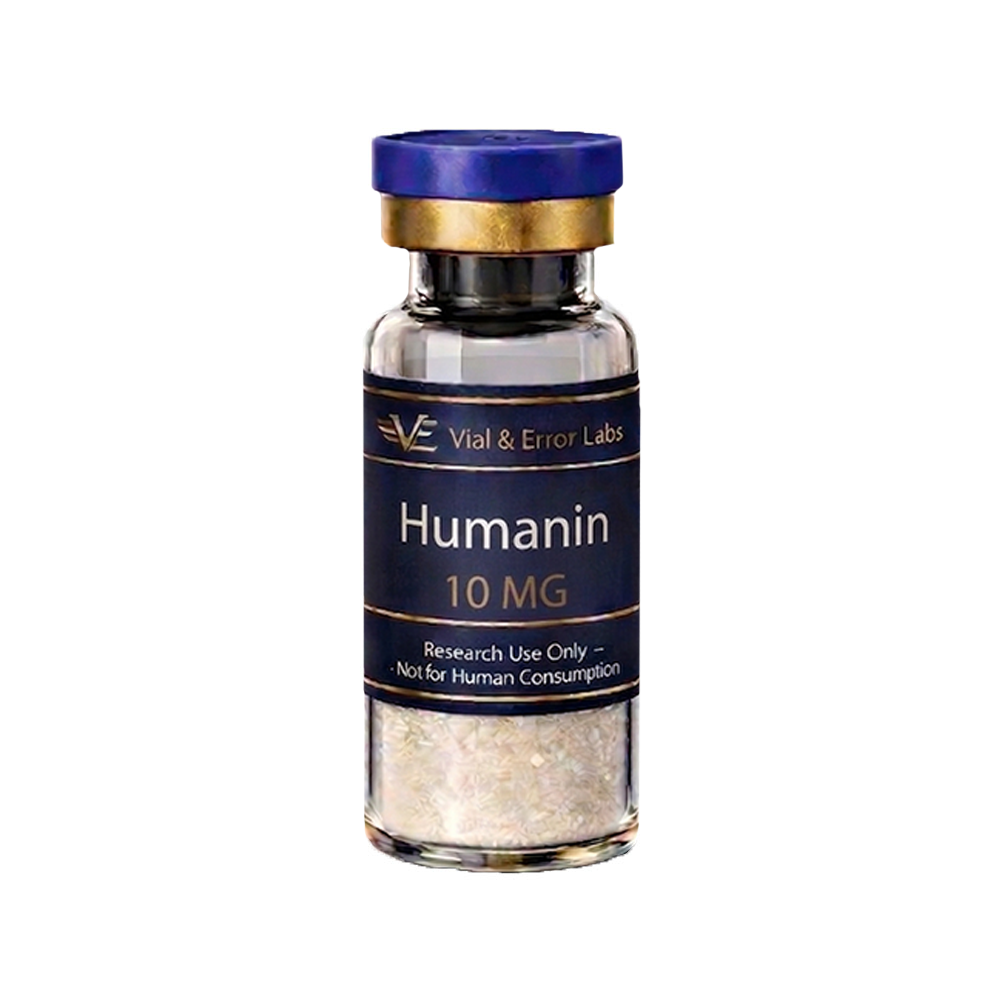
Description
-
About Humanin
Humanin — a 21-amino acid mitochondria-derived peptide (MDP, CAS 326469-29-8) encoded within the 16S rRNA gene of the mitochondrial genome — is one of the founding members of the mitochondria-derived peptide class, alongside MOTS-c and SHLPs. It is supplied as a laboratory-grade lyophilized powder intended strictly for analytical and non-clinical research applications.
Humanin was originally identified as a suppressor of neuronal apoptosis in Alzheimer s disease cell models and has since been shown to act through three identified receptors: CNTFR/WSX-1/gp130 heterotrimer, FPRL1 (formyl peptide receptor-like 1), and intracellular binding to Bax. Circulating Humanin levels decline with age and in metabolic disease, positioning it as a biomarker in aging biology research. As a research tool, Humanin is used in neuroblastoma, hepatocyte, cardiomyocyte, and primary neuron models to study anti-apoptotic signaling (Bcl-2/Bax regulation), STAT3 pathway activation, IGF-1/insulin signaling crosstalk, and mitochondrial-nuclear communication in aging and metabolic stress models.
COMMON RESEARCH APPLICATIONS
Anti-Apoptotic Signaling in Neuronal Models
Humanin is examined in SH-SY5Y and primary cortical neuron models under amyloid-β and doxorubicin challenge to study Bax sequestration, STAT3 phosphorylation via CNTFR/WSX-1/gp130 receptor activation, and mitochondrial apoptosis pathway inhibition.Mitochondria-Derived Peptide (MDP) Signaling Research
Used alongside MOTS-c and SHLPs to study mitochondria-to-nucleus retrograde signaling, IGF-1/insulin receptor sensitization, and AMPK co-activation in hepatocyte and skeletal muscle models examining metabolic stress responses.Aging Biology & Cellular Senescence Studies
Humanin circulating levels decline with age; used in senescent cell models (SA-β-gal, p21/p16 expression) to study MDP-mediated inhibition of age-associated apoptosis, SASP pathway modulation, and age-related metabolic dysfunction markers.Comparative MDP Class Benchmarking
Reference compound for the mitochondria-derived peptide family. Benchmarked alongside MOTS-c in AMPK and insulin signaling studies, and alongside SHLPs in IGFR/STAT3 pathway activation assays to map overlapping vs. distinct MDP receptor engagement profiles. -
Chemical Identity
Compound Name: Humanin
Internal Catalog Code: Humanin
CAS Number: 326469-29-8
Molecular Formula: C100H163N33O28S
Molecular Weight: 2284.60 g/mol
Physical Properties
Form/Appearance: Lyophilized powder
Quality & Testing
Purity: As listed on lot-specific COA
Testing Method : HPLC (as applicable) · identity confirmation per COA
Verification
COA: Lot-specific, included with order (QR on label)
Handling & Storage
Storage Temperature: Store desiccated at −20°C for long-term; 2–8°C short-term. Protect from light. Refer to SDS/COA for compound-specific handling.
Light Sensitivity: Protect from light
Moisture: Store desiccated when applicable
Available Strengths: 10 mg
SKU (10 mg): VE-HUMA-010
-
-
What is this product?
Humanin (CAS 326469-29-8, MW 2284.60 g/mol, C₁₀₀H₁₆₃N₃₃O₂₈S) is supplied as a lyophilized 21-amino acid mitochondria-derived peptide (MDP) for laboratory research use only. It is studied in anti-apoptotic signaling and aging biology research. Available as VE-HUMA-010 (10 mg).
-
What purity and testing methods are used?
Each lot is tested by reverse-phase HPLC and MS confirmation to ≥98% purity with sequence verification. A lot-specific COA is included with every order, accessible via QR code on the label.
-
What are the key chemical identifiers?
CAS 326469-29-8 · Molecular formula C₁₀₀H₁₆₃N₃₃O₂₈S · MW 2284.60 g/mol · 21-aa sequence: MAPRGFSCLLLLTSEIDLPVK · Synonyms: mitochondria-derived peptide Humanin, MDP Humanin, 16S rRNA-encoded peptide.
-
What signaling pathways does Humanin address in research models?
Humanin is studied for: (1) anti-apoptotic signaling via STAT3 phosphorylation through CNTFR/WSX-1/gp130 receptor; (2) direct Bax sequestration to block mitochondrial apoptosis; (3) IGF-1R/insulin receptor signaling sensitization; and (4) AMPK-mediated metabolic regulation in hepatocyte and cardiomyocyte models under metabolic stress.
-
How is Humanin reconstituted for research use?
Dissolve in sterile water or PBS (pH 7.4) at ~1 mg/mL. Use immediately or aliquot and store at −80°C. Avoid repeated freeze-thaw cycles (the internal Cys residue can oxidize). Protect from light and air.
-
What is the recommended storage upon receipt?
Store immediately at −20°C desiccated. For extended stability, −80°C is preferred. Short-term at 2–8°C acceptable for up to 1 week. Inspect vials for integrity upon receipt.
-
What is a COA and why does it matter?
A COA documents lot-specific purity (HPLC ≥98%), MS identity confirmation, and sequence verification. Humanin contains a Cys residue susceptible to oxidation — COA review is essential to confirm the reduced, active form. Each lot ships with a QR-accessible COA. Review before use.
-
What is this product?
Reviews
There are no reviews yet.