

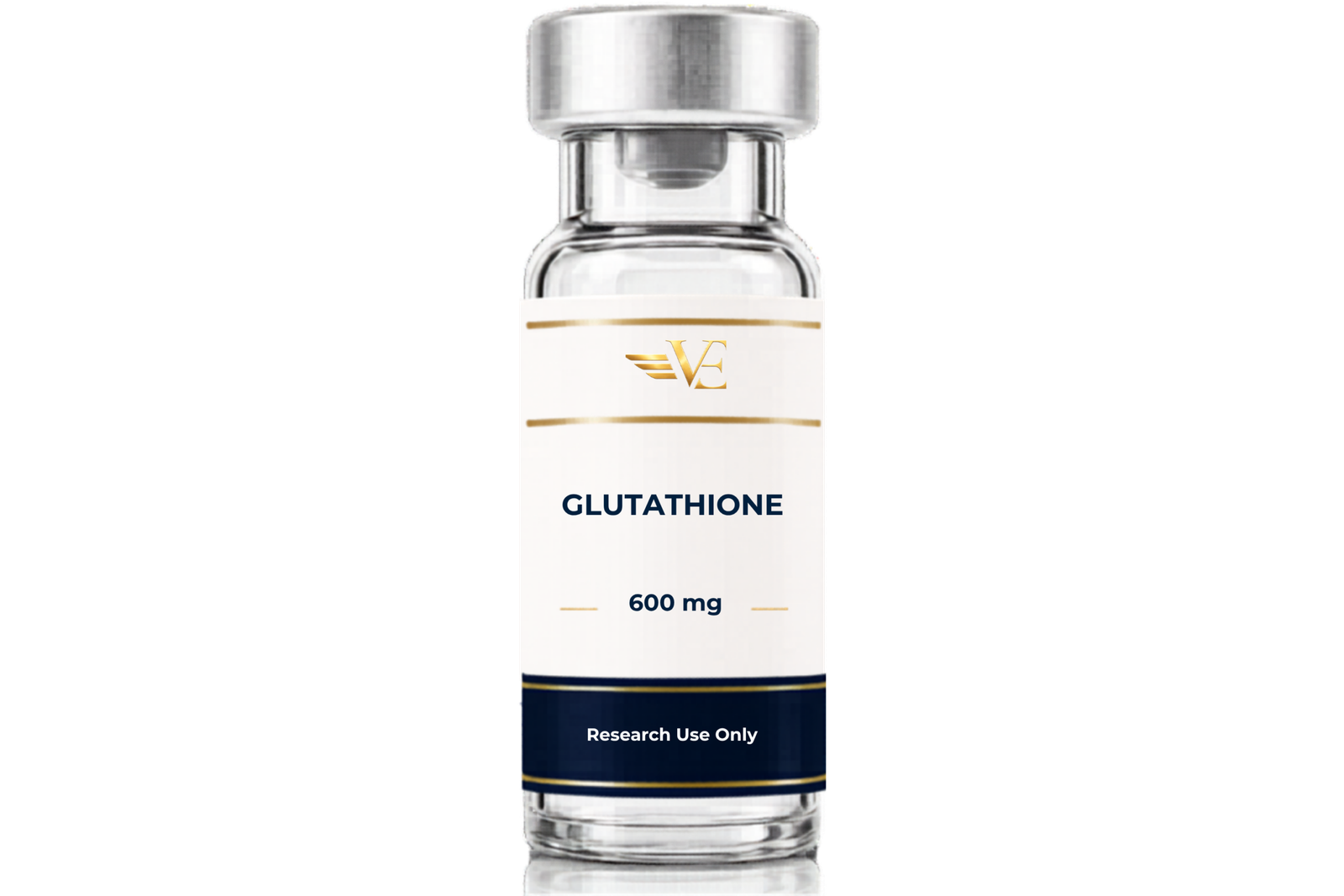
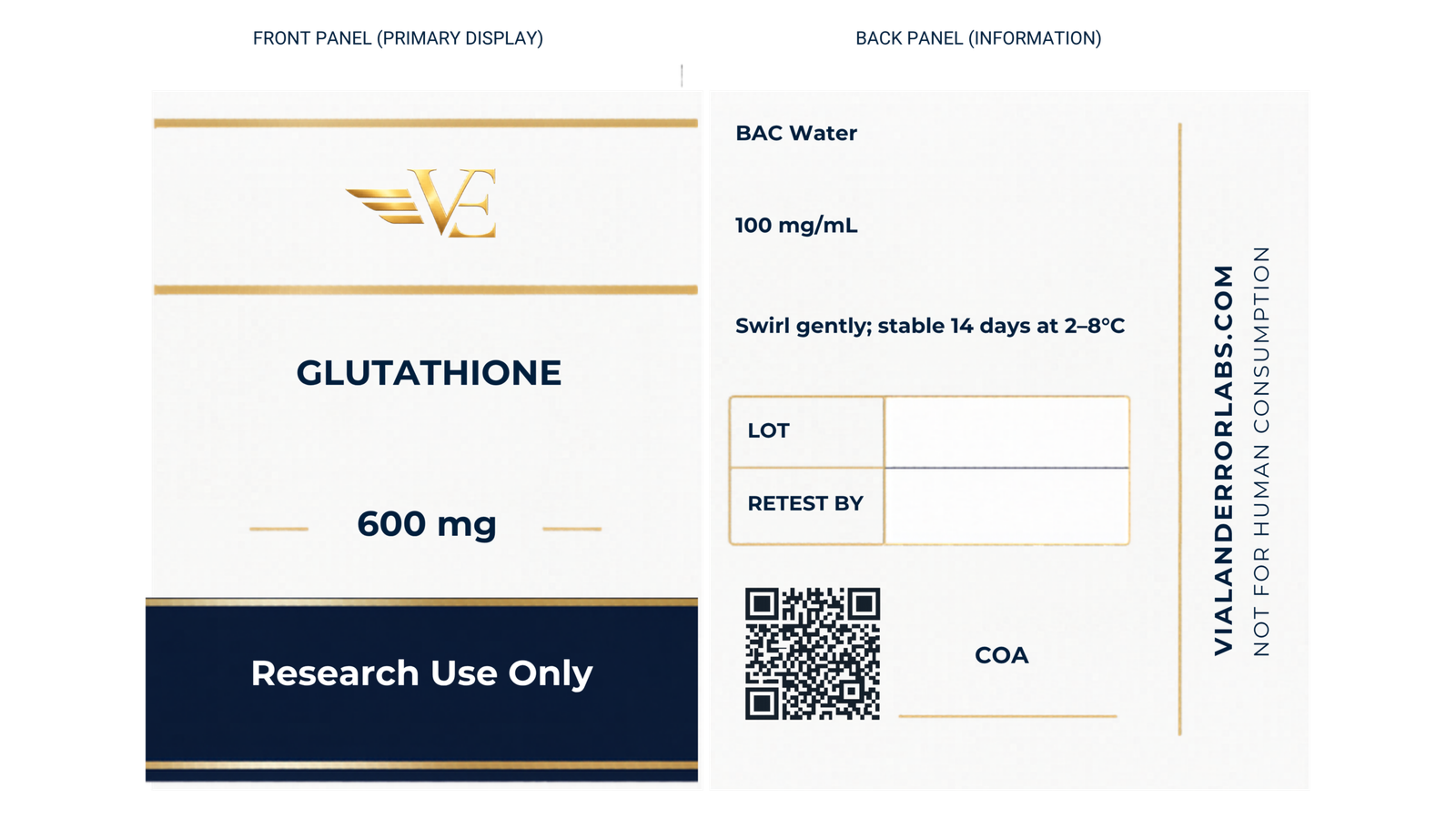
Description
-
About Glutathione (GSH / γ-L-Glutamyl-L-cysteinylglycine)
Glutathione — commonly abbreviated as GSH (CAS 70-18-8) — is a naturally occurring tripeptide antioxidant and one of the most widely referenced cellular redox compounds in oxidative stress and metabolic pathway research. It is supplied as a laboratory-grade lyophilized compound intended strictly for analytical and non-clinical research applications.
Unlike isolated antioxidant scavengers that primarily neutralize reactive oxygen species directly, glutathione functions as a central intracellular redox regulator involved in thiol signaling, mitochondrial defense mechanisms, detoxification pathways, and cellular oxidative balance. This makes it a widely utilized research tool for studying redox biology, antioxidant response systems, and cellular stress adaptation models.
COMMON RESEARCH APPLICATIONS
Cellular Redox State & GSH/GSSG Ratio Assays
Reference standard for GSH quantification using luminescent (Promega GSH-Glo), colorimetric (DTNB/Ellman s), or HPLC-based GSH/GSSG assays. Used to calibrate redox state measurements in oxidative stress models (H₂O₂, tBHP, BSO-induced depletion).Nrf2/Keap1 Pathway Research
GSH depletion (BSO co-treatment) activates Nrf2/Keap1 antioxidant response. Used alongside buthionine sulfoximine (BSO) and Nrf2 activators (sulforaphane, CDDO-Me) to study antioxidant response element (ARE) gene activation and GSH biosynthesis enzyme induction (GCL, GS).Glutathione S-Transferase (GST) Assays
Substrate for GST activity assays using CDNB as electrophilic co-substrate. Used to characterize GST isoform activity, xenobiotic conjugation, and Phase II detoxification enzyme kinetics.Ferroptosis & Redox Biology Research
GSH is the co-substrate for GPx4 (glutathione peroxidase 4), which suppresses lipid peroxidation and ferroptotic cell death. Used in RSL3/erastin ferroptosis models to study GPx4 activity, lipid ROS accumulation, and cell death thresholds. -
Chemical Identity
Compound Name: Glutathione (reduced, GSH)
Synonyms: GSH · γ-L-Glutamyl-L-cysteinylglycine · L-glutathione · reduced glutathione · γ-glutamylcysteinylglycine
CAS Number: 70-18-8
EC Number: 200-725-4
Molecular Formula: C₁₀H₁₇N₃O₆S
Molecular Weight: 307.32 g/mol
Physical Properties
Appearance: White crystalline powder
Solubility (water): ~10 mg/mL in sterile water (pH 3–5, stable); unstable at neutral/alkaline pH
Solubility (organic): Insoluble in ethanol, DMSO
Hygroscopic: Yes — store desiccated; sensitive to oxidation
Quality & Testing
Purity: ≥98% (HPLC)
Testing Method : Reverse-phase HPLC · Ellman's reagent (DTNB) thiol content verification
Verification
COA: Lot-specific, included with order (QR on label)
SDS Supplier : See SDS/MSDS · OSHA HCS / GHS compliant
Handling & Storage
Storage Temperature: Store desiccated at −20°C. Protect from air and moisture. GSH oxidizes readily — minimize exposure to oxygen during handling.
Light Sensitivity: Protect from light
Reconstitution: Dissolve in deoxygenated, acidified water (pH 3–5) to prevent oxidation. Prepare fresh solutions; do not store reconstituted solution at neutral pH
Available Strengths: 100 mg · 500 mg
SKU (600 mg): VE-GSH-600
SKU (1500 mg): VE-GSH-1500
-
-
What is this product?
Glutathione (reduced, GSH) is supplied as a crystalline free acid (CAS 70-18-8, MW 307.32 g/mol) for laboratory research use only. It is the most abundant intracellular thiol antioxidant tripeptide in mammalian cells.
-
What purity and testing methods are used?
Each lot is tested by reverse-phase HPLC and Ellman's reagent (DTNB) thiol content verification to ≥98% purity. A lot-specific COA is included with every order, accessible via QR code on the label.
-
What are the key chemical identifiers?
CAS 70-18-8 · EC Number 200-725-4 · Molecular formula C₁₀H₁₇N₃O₆S · MW 307.32 g/mol · Synonyms: GSH, γ-L-glutamyl-L-cysteinylglycine, L-glutathione, reduced glutathione.
-
How is glutathione reconstituted for research use?
Dissolve in deoxygenated, acidified water (pH 3–5) at ~10 mg/mL. GSH oxidizes rapidly at neutral/alkaline pH. Prepare fresh solutions immediately before use. Do not store reconstituted solutions at neutral pH. DMSO and ethanol are not suitable solvents.
-
What is the difference between GSH and GSSG in research applications?
GSH (reduced glutathione) is the biologically active thiol form and cellular antioxidant. GSSG (oxidized glutathione) is the disulfide dimer formed after ROS neutralization, regenerated by glutathione reductase (GR). The GSH:GSSG ratio (typically >100:1 in healthy cells) is used as a quantitative redox state indicator.
-
What is the recommended storage upon receipt?
Store immediately at −20°C desiccated and protected from air. GSH oxidizes readily upon exposure to oxygen. Aliquot to minimize freeze-thaw cycles. Inspect for white crystalline appearance upon receipt.
-
What is a COA and why does it matter?
A COA documents lot-specific purity (HPLC ≥98%), thiol content (Ellman's assay), and redox integrity. Thiol content verification is critical — partially oxidized GSH lots will underperform in enzymatic assays. Each lot ships with a QR-accessible COA.
-
What is this product?
-
PubMed Literature Search — Glutathione
Primary literature · 50,000+ indexed studies (core cellular antioxidant)
Open PubMedPubChem Compound Record
Full chemical data, bioassays, patents
View RecordSupplier Product Insert / Technical Data Sheet
Thiol content verification, oxidation sensitivity notes, storage protocol
Download PDF