


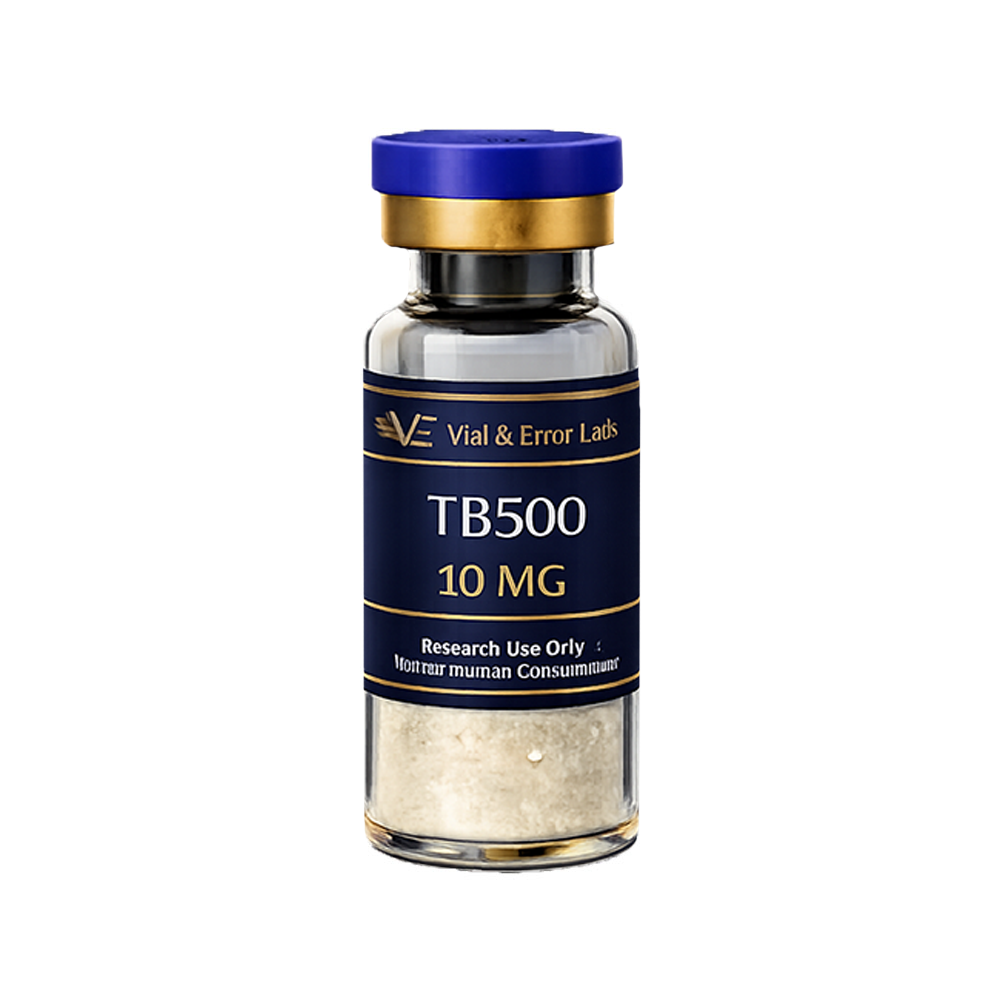
Description
-
About TB-500 (Thymosin Beta-4 fragment / Tβ4)
TB-500 — a synthetic version of the active region of Thymosin Beta-4 (Tβ4, CAS 77591-33-4) — is a 43-amino acid peptide studied extensively in preclinical models of tissue repair and angiogenesis. The biologically active core of Tβ4 includes the actin-sequestering LKKTET motif, which regulates G-actin/F-actin dynamics, cell migration, and cytoskeletal reorganization. TB-500 is also the precursor to Ac-SDKP, a tetrapeptide with distinct anti-inflammatory and antifibrotic properties studied in cardiac and renal fibrosis models. It remains one of the most-studied synthetic peptides for musculoskeletal and cardiovascular tissue signaling research. Supplied as lyophilized peptide for non-clinical research use only.
COMMON RESEARCH APPLICATIONS
Actin Dynamics & Cell Migration
TB-500 sequesters G-actin via its LKKTET motif, modulating F-actin polymerization and lamellipodia formation. Used in transwell migration assays and wound scratch models to study actin-mediated cell motility in fibroblasts, endothelial cells, and satellite cells.Angiogenesis Research
Promotes endothelial tube formation and VEGF expression in HUVEC models. Used to study Tβ4-driven angiogenic signaling in hypoxia-challenged and growth factor-depleted systems alongside VEGF and BPC-157 as comparators.Cardiac & Muscle Regeneration Signaling
Studied for cardiomyocyte survival and epicardial progenitor activation in cardiac injury models; used in C2C12 myoblast differentiation assays to examine Tβ4-mediated satellite cell activation and myotube formation.Anti-Fibrotic Pathway Research
Ac-SDKP (TB-500 metabolite) suppresses TGF-β1-driven collagen deposition in cardiac and renal fibroblast models. Used to study ACE/ACE2 axis modulation and anti-fibrotic gene expression. -
Chemical Identity
Compound Name: TB-500
Synonyms: Thymosin Beta-4 fragment · Tβ4 synthetic analog · Ac-SDKP (N-terminal tetrapeptide, related) · thymosin β4
CAS Number: 77591-33-4
EC Number: N/A (synthetic peptide)
Molecular Formula: C₂₁₂H₃₅₀N₅₆O₇₈S
Molecular Weight: 4963.49 g/mol
Physical Properties
Appearance: White to off-white lyophilized powder
Solubility (water): ~1 mg/mL in sterile water or PBS (pH 7.4)
Solubility (organic): Limited in DMSO; not recommended for organic solvent applications
Hygroscopic: Yes — store desiccated
Quality & Testing
Purity: ≥98% (HPLC)
Testing Method : Reverse-phase HPLC · MS confirmation · sequence verification
Verification
COA: Lot-specific, included with order (QR on label)
SDS Supplier : See SDS/MSDS · OSHA HCS / GHS compliant
SDS Revision:
Handling & Storage
Storage Temperature: Store desiccated at −20°C long-term; 2–8°C short-term. Protect from light. Refer to SDS/COA for compound-specific handling.
Light Sensitivity: Protect from light
Reconstitution: Dissolve in sterile water or PBS (pH 7.4) at ~1 mg/mL; use immediately or aliquot and store at −80°C
Available Strengths: 10 mg
SKU (10 mg): VE-TB500-010
-
-
What is this product?
TB-500 is supplied as a lyophilized 43-amino acid synthetic peptide (CAS 77591-33-4, MW 4963.49 g/mol) based on the active region of Thymosin Beta-4, intended for laboratory research use only.
-
What purity and testing methods are used?
Each lot is tested by reverse-phase HPLC and MS confirmation to ≥98% purity with sequence verification. A lot-specific COA is included with every order, accessible via QR code on the label.
-
What are the key chemical identifiers?
CAS 77591-33-4 · Molecular formula C₂₁₂H₃₅₀N₅₆O₇₈S · MW 4963.49 g/mol · Synonyms: Thymosin Beta-4 fragment, Tβ4, Ac-SDKP precursor.
-
How is TB-500 reconstituted for research use?
Dissolve in sterile water or PBS (pH 7.4) at ~1 mg/mL. Use immediately after reconstitution or aliquot and store at −80°C. DMSO is not recommended. Avoid repeated freeze-thaw cycles. Protect from light.
-
What signaling pathways does TB-500 affect in research models?
TB-500 primarily acts through actin sequestration via the LKKTET motif, affecting cell migration, angiogenesis (VEGF/VEGFR2), and cytoskeletal dynamics. Its metabolite Ac-SDKP suppresses TGF-β1 signaling and collagen deposition in fibrosis models.
-
What is the recommended storage upon receipt?
Store immediately at −20°C desiccated. For long-term stability, −80°C is preferred after aliquoting. Short-term at 2–8°C acceptable. Inspect vials for integrity upon receipt.
-
What is a COA and why does it matter?
A COA documents lot-specific purity (HPLC ≥98%), sequence verification (MS), and appearance. Each TB-500 lot ships with a QR-accessible COA. Review before use to confirm identity and purity meet your experimental requirements.
-
What is this product?
Reviews
There are no reviews yet.