


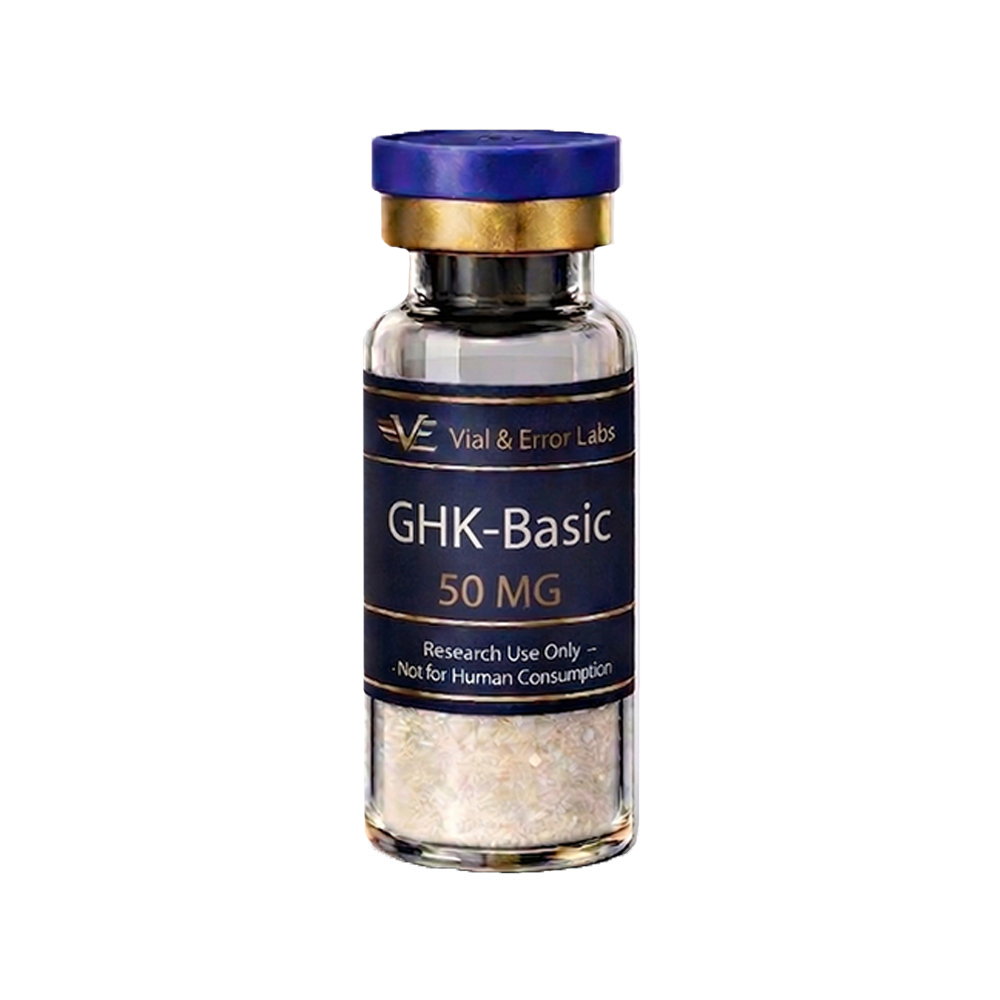
Description
-
About GHK Basic
GHK (glycyl-L-histidyl-L-lysine, CAS 49557-75-7) is the free-base tripeptide form of the endogenous plasma copper-binding peptide. It is studied as the unchelated parent peptide scaffold in skin biology, collagen remodeling, and ECM signaling research prior to copper complexation, and as a reference standard in GHK-Cu mechanistic studies. It is supplied as a laboratory-grade lyophilized powder intended strictly for analytical and non-clinical research applications.
Unlike GHK-Cu, the free-base GHK tripeptide allows researchers to isolate peptide-only versus copper-coordinated effects in fibroblast and keratinocyte models. GHK activates a broad range of wound healing and matrix-remodeling genes and has been shown to modulate collagen, fibronectin, and decorin synthesis in fibroblast models without copper-dependent redox activity. Researchers use GHK basic as an unchelated control compound, reference standard, and precursor in copper-chelation study designs examining ECM remodeling, Nrf2 antioxidant pathway activation, and skin barrier gene expression.
COMMON RESEARCH APPLICATIONS
Collagen Gene Expression Assays
GHK basic is used as the unchelated control in collagen synthesis studies alongside GHK-Cu. Used in HDFa and CCD-1079Sk dermal fibroblast models to isolate peptide-only vs. copper-dependent contributions to COL1A1, COL1A2, and COL3A1 gene upregulation.ECM Remodeling Pathway Research
Used in fibroblast and 3D skin equivalent models to study fibronectin, decorin, and MMP-2/MMP-9 expression changes in response to the free peptide backbone, providing a copper-free baseline for ECM signaling pathway mapping.Peptide–Copper Chelation Studies
Reference ligand for studying Gly-His-Lys copper(II) binding affinity, chelation kinetics, and Cu²⁺ transfer to other biological ligands. Used in spectrophotometric and ITC binding assays comparing GHK free-base vs. GHK-Cu chelated complex.Comparative GHK / GHK-Cu Benchmarking
Paired control compound in studies examining copper-dependent vs. copper-independent peptide bioactivity. Enables direct side-by-side comparison of unchelated vs. chelated GHK effects on Nrf2 pathway activation, wound healing assays, and anti-inflammatory gene expression. -
Chemical Identity
Compound Name: GHK basic
Internal Catalog Code: GHK basic
CAS Number: 49557-75-7
Molecular Formula: C14H22N4O4
Molecular Weight: 298.36 g/mol
Physical Properties
Form/Appearance: Lyophilized powder
Quality & Testing
Purity: As listed on lot-specific COA
Testing Method : HPLC (as applicable) · identity confirmation per COA
Verification
COA: Lot-specific, included with order (QR on label)
Handling & Storage
Storage Temperature: Store desiccated at −20°C for long-term; 2–8°C short-term. Protect from light. Refer to SDS/COA for compound-specific handling.
Light Sensitivity: Protect from light
Moisture: Store desiccated when applicable
Available Strengths: 50 mg
SKU (50 mg): VE-GHKB-050
-
-
What is this product?
GHK basic (glycyl-L-histidyl-L-lysine, CAS 49557-75-7, MW 298.36 g/mol) is the free-base, unchelated form of the endogenous plasma tripeptide, supplied as a lyophilized powder for laboratory research use only. It is the peptide precursor used in GHK-Cu chelation studies. Available as VE-GHKB-050 (50 mg).
-
What purity and testing methods are used?
Each lot is tested by reverse-phase HPLC and MS confirmation with sequence verification. A lot-specific COA is included with every order, accessible via QR code on the label.
-
What are the key chemical identifiers?
CAS 49557-75-7 · Molecular formula C₁₄H₂₂N₄O₄ · MW 298.36 g/mol · Sequence: Gly-His-Lys · Synonyms: glycyl-L-histidyl-L-lysine, GHK free base, GHK tripeptide (unchelated).
-
How is GHK basic reconstituted for research use?
Dissolve in sterile water (pH 6–7) at ~10 mg/mL. Stable at neutral pH; avoid alkaline conditions. Use immediately or aliquot and store at −80°C. Protect from light.
-
What is the recommended storage upon receipt?
Store immediately at −20°C in a desiccated environment. Short-term at 2–8°C is acceptable. Inspect vials for integrity upon receipt.
-
What is a COA and why does it matter?
A COA documents lot-specific purity (HPLC), sequence verification (MS: Gly-His-Lys confirmed), and appearance. Each GHK basic lot ships with a QR-accessible COA. Review before use to confirm identity and purity meet your experimental requirements — especially important when used as a control compound in copper chelation studies.
-
What is this product?
Reviews
There are no reviews yet.