


Description
-
About Vesugen
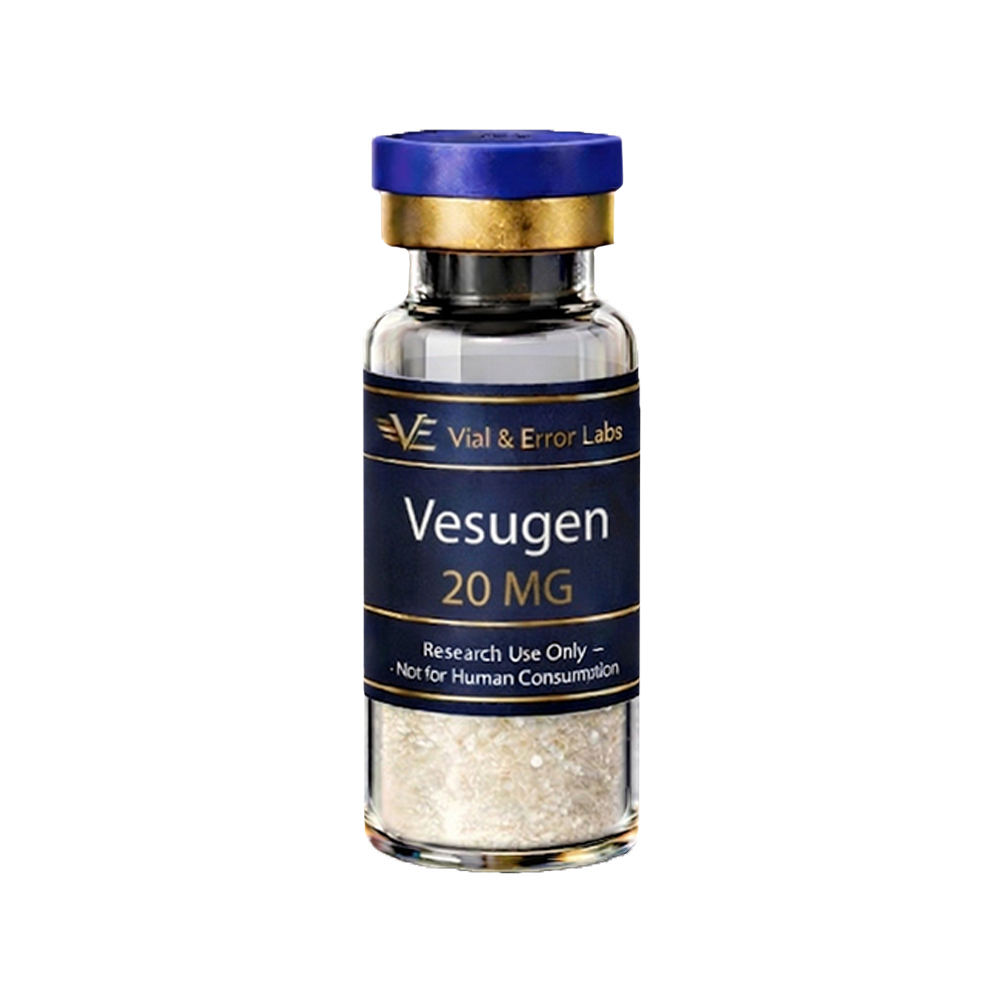
Vesugen — a synthetic Lys-Glu-Asp-Ala tetrapeptide (CAS 135537-16-5) from the Khavinson peptide bioregulator series — is a tissue-specific peptide studied as a model vascular endothelial and blood vessel cytoprotective signal in vascular biology and angiogenesis research. It is supplied as a laboratory-grade lyophilized powder intended strictly for analytical and non-clinical research applications.
As a member of the short peptide bioregulator family developed at the St. Petersburg Institute of Bioregulation and Gerontology, Vesugen is investigated for its selectivity toward vascular endothelial cell and smooth muscle cell signaling models. Researchers use Vesugen in HUVEC, HAEC, and HVSMC (human vascular smooth muscle cell) models to examine effects on endothelial cell proliferation and migration (VEGF/VEGFR2 pathway activation), eNOS/NO signaling and vascular tone markers, ICAM-1/VCAM-1 inflammatory adhesion molecule expression, oxidative stress response in endothelium (Nrf2/HO-1/eNOS axis), and senescence-associated secretory phenotype (SASP) markers under standardized in vitro conditions.
COMMON RESEARCH APPLICATIONS
Endothelial Cell Signaling & eNOS Pathway Research
Vesugen is examined in HUVEC and HAEC models to study VEGFR2/PI3K/Akt/eNOS pathway activation, nitric oxide (NO) production (Griess assay, DAF-FM fluorescence), and endothelial proliferation as vascular function endpoint markers.Vascular Inflammation & Adhesion Molecule Expression
Used in TNF-α and IL-1β cytokine-challenged HUVEC models to characterize ICAM-1, VCAM-1, and E-selectin expression, NF-κB pathway modulation, and monocyte adhesion as endothelial inflammatory pathway endpoint markers.Endothelial Senescence & Aging Vascular Biology
Examined in serial-passaged HUVEC models to study p21/p53/SA-β-gal senescence markers, SASP cytokine secretion (IL-6, IL-8, MMP-3), and Nrf2/HO-1 antioxidant pathway activation as vascular aging endpoint characterization tools.Comparative Khavinson Vascular Peptide Screening
Benchmarked alongside related Khavinson tetrapeptides (Livagen, Cardiogen) to characterize tissue-selective vascular endothelial vs. cardiac signaling profiles and shared vs. distinct features within the vascular-targeted short peptide bioregulator class. -
Chemical Identity
Compound Name: Vesugen
Internal Catalog Code: Vesugen
CAS Number: 135537-16-5
Molecular Formula: C18H33N5O7
Molecular Weight: 435.48 g/mol
Physical Properties
Form/Appearance: Lyophilized powder
Quality & Testing
Purity: As listed on lot-specific COA
Testing Method : HPLC (as applicable) · identity confirmation per COA
Verification
COA: Lot-specific, included with order (QR on label)
Handling & Storage
Storage Temperature: Store desiccated at −20°C for long-term; 2–8°C short-term. Protect from light. Refer to SDS/COA for compound-specific handling.
Light Sensitivity: Protect from light
Moisture: Store desiccated when applicable
Available Strengths: 20 mg
SKU (20 mg): VE-VESU-020
-
-
What is this product?
Vesugen (CAS 135537-16-5, MW 435.48 g/mol, C₁₈H₃₃N₅O₇) is a synthetic Lys-Glu-Asp-Ala tetrapeptide from the Khavinson bioregulator series, supplied as a lyophilized powder for laboratory research use only. It is studied as a model vascular endothelial cytoprotective peptide. Available as VE-VESU-020 (20 mg).
-
What purity and testing methods are used?
Each lot is tested by reverse-phase HPLC and MS confirmation to ≥98% purity with sequence verification. A lot-specific COA is included with every order, accessible via QR code on the label.
-
What are the key chemical identifiers?
CAS 135537-16-5 · Molecular formula C₁₈H₃₃N₅O₇ · MW 435.48 g/mol · Sequence: Lys-Glu-Asp-Ala · Synonyms: KEDA, Khavinson vascular peptide, vascular endothelial cytoprotective tetrapeptide.
-
What signaling pathways does Vesugen address in research models?
Vesugen is studied in endothelial and vascular cell models for: VEGF/VEGFR2/eNOS pathway activation and NO production, ICAM-1/VCAM-1/E-selectin expression under cytokine challenge (TNF-α, IL-1β), Nrf2/HO-1/NQO1 antioxidant pathway in endothelium, PI3K/Akt/mTOR endothelial survival signaling, and senescence markers (p21/p53/SA-β-gal) under oxidative stress and serial passaging models.
-
How is Vesugen reconstituted for research use?
Dissolve in sterile water or PBS (pH 7.0) at ~5 mg/mL. Use immediately or aliquot and store at −80°C. Avoid repeated freeze-thaw cycles. Protect from light.
-
What is the recommended storage upon receipt?
Store immediately at −20°C desiccated. Short-term at 2–8°C acceptable for up to 2 weeks. Inspect vials for integrity upon receipt.
-
What is a COA and why does it matter?
A COA documents lot-specific purity (HPLC ≥98%), sequence verification (MS: Lys-Glu-Asp-Ala confirmed), and appearance. Each Vesugen lot ships with a QR-accessible COA. Review before use to confirm identity and purity meet your experimental requirements.
-
What is this product?
Reviews
There are no reviews yet.