


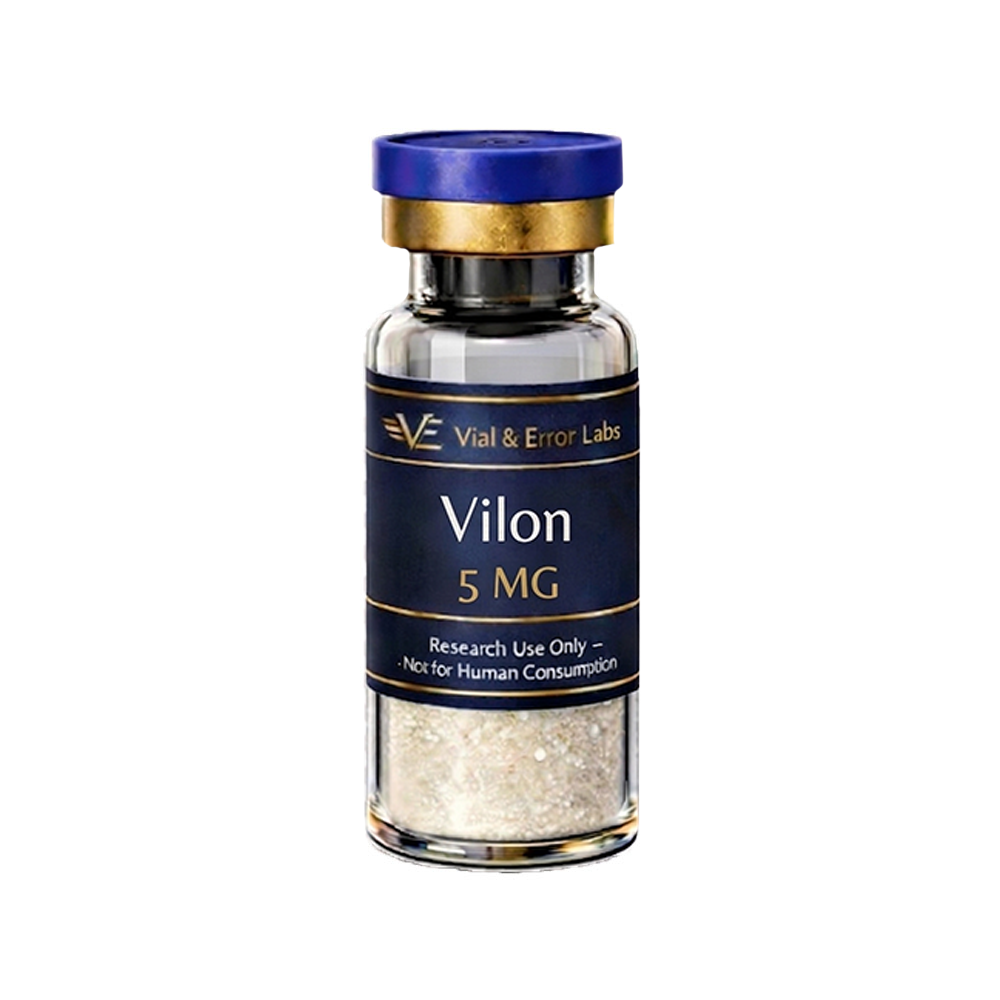
Description
-
About Vilon
Vilon — a synthetic Lys-Glu dipeptide (CAS 62008-36-0) from the Khavinson peptide bioregulator series — is the shortest peptide in the series and is studied as a model immune modulation signal in T-cell biology and thymic aging research. At just two amino acids, Vilon is among the smallest biologically active peptides in research use. It is supplied as a laboratory-grade lyophilized powder intended strictly for analytical and non-clinical research applications.
Vilon was developed alongside Thymalin and Crystagen as part of the thymic peptide bioregulator program at the St. Petersburg Institute of Bioregulation and Gerontology. Its extreme brevity makes it a particularly clean pharmacological tool for studying minimal peptide-mediated immune signaling, as the dipeptide can act as a direct gene expression modulator through chromatin interaction without receptor engagement requirements. Researchers use Vilon in Jurkat T-cell, primary human PBMC, thymocyte, and splenocyte models to examine T-helper cell activation and differentiation (CD4/IFN-γ/IL-2 markers), anti-apoptotic pathway signaling (Bcl-2/Bax in aging lymphocytes), IL-2/IL-7 T-cell survival pathway, and comparative immunomodulatory activity versus Thymalin and Crystagen under standardized in vitro conditions.
COMMON RESEARCH APPLICATIONS
T-Helper Cell Activation & Aging Lymphocyte Studies
Vilon (Lys-Glu) is examined in primary human PBMC and aging mouse splenocyte models to study T-helper cell activation markers (CD4, IFN-γ, IL-2 expression), anti-apoptotic pathway changes (Bcl-2/Bax ratio), and age-associated lymphocyte proliferation endpoint characterization.Minimal Peptide Gene Expression Modulation
As the shortest active peptide in the Khavinson series, Vilon is used in chromatin accessibility (ATAC-seq), histone modification (ChIP), and transcriptomic studies to investigate direct dipeptide–DNA/histone interactions and gene reactivation mechanisms.Comparative Khavinson Immune Series
Benchmarked in parallel with Crystagen (3 aa), Thymalin (8 aa), and Timogen (2 aa, Glu-Trp) in standardized immune cell activation assays to characterize the relationship between peptide chain length, sequence, and T-cell vs. B-cell activation specificity.Aging Biology & Immunosenescence Research
Used in aging immune cell models and replicative senescence paradigms to study immunosenescence pathway markers (p21, p53, SASP), Th1/Th2 cytokine balance shifts, and the effect of short bioregulatory dipeptides on age-related immune function decline. -
Chemical Identity
Compound Name: Vilon
Internal Catalog Code: Vilon
CAS Number: 62008-36-0
Molecular Formula: C8H14N4O5
Molecular Weight: 246.22 g/mol
Physical Properties
Form/Appearance: Lyophilized powder
Quality & Testing
Purity: As listed on lot-specific COA
Testing Method : HPLC (as applicable) · identity confirmation per COA
Verification
COA: Lot-specific, included with order (QR on label)
Handling & Storage
Storage Temperature: Store desiccated at −20°C for long-term; 2–8°C short-term. Protect from light. Refer to SDS/COA for compound-specific handling.
Light Sensitivity: Protect from light
Moisture: Store desiccated when applicable
Available Strengths: 5 mg · 10 mg · 20 mg
SKU (5 mg): VE-VILO-005
SKU (10 mg): VE-VILO-010
SKU (20 mg): VE-VILO-020
-
-
What is this product?
Vilon (CAS 62008-36-0, MW 246.22 g/mol, C₈H₁₄N₄O₅) is the Lys-Glu dipeptide from the Khavinson bioregulator series, supplied as a lyophilized powder for laboratory research use only. It is the shortest peptide in the Khavinson immune series, studied in T-cell and thymic aging models. Available as VE-VILO-020 (20 mg).
-
What purity and testing methods are used?
Each lot is tested by reverse-phase HPLC and MS confirmation to ≥98% purity with dipeptide sequence verification. A lot-specific COA is included with every order, accessible via QR code on the label.
-
What are the key chemical identifiers?
CAS 62008-36-0 · Molecular formula C₈H₁₄N₄O₅ · MW 246.22 g/mol · Sequence: Lys-Glu (H-Lys-Glu-OH) · Synonyms: KE dipeptide, Khavinson immune dipeptide, thymic dipeptide bioregulator.
-
What makes Vilon mechanistically distinct from other Khavinson immune peptides?
Vilon (Lys-Glu, 2 aa) is the minimal pharmacophore in the Khavinson immune series. Unlike Thymalin (8 aa) and Crystagen (3 aa), the KE dipeptide is studied for direct chromatin interaction and gene expression modulation via interaction with DNA-binding proteins — without requiring classical GPCR or receptor-tyrosine kinase engagement. This makes Vilon a unique tool for studying minimal peptide-mediated epigenetic and transcriptional effects in immune aging models.
-
How is Vilon reconstituted for research use?
Dissolve in sterile water or PBS (pH 7.0) at ~5 mg/mL. Given its small size and high water solubility, Vilon reconstitutes readily. Use immediately or aliquot and store at −80°C. Protect from light.
-
What is the recommended storage upon receipt?
Store immediately at −20°C desiccated. Short-term at 2–8°C acceptable for up to 2 weeks. Inspect vials for integrity upon receipt. As a dipeptide, Vilon is more susceptible to hydrolysis than larger peptides — keep cold and desiccated.
-
What is a COA and why does it matter?
A COA documents lot-specific purity (HPLC ≥98%), MS identity confirmation (Lys-Glu confirmed), and appearance. For a dipeptide, purity is especially critical — even minor contaminants represent a larger molar fraction. Each lot ships with a QR-accessible COA. Review before use.
-
What is this product?
Reviews
There are no reviews yet.