


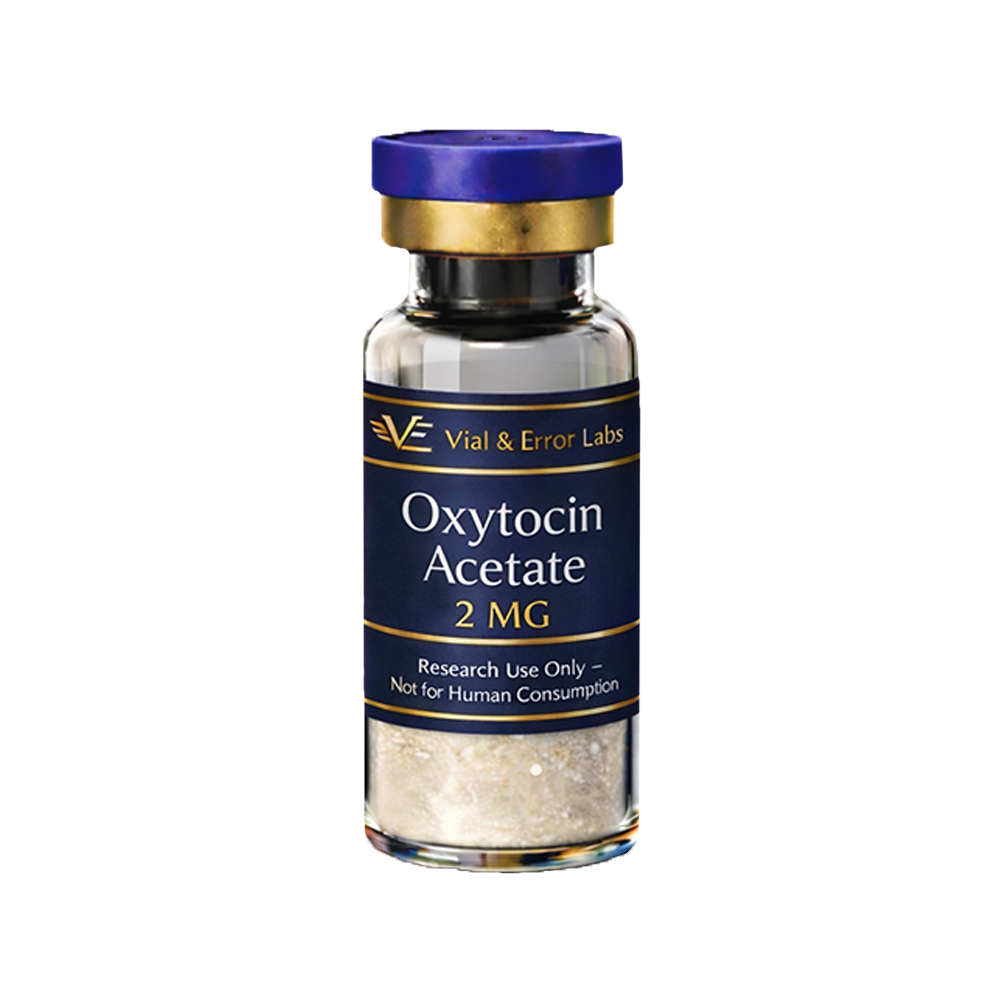
Description
-
About Oxytocin Acetate
Oxytocin Acetate (CAS 6233-83-6) is the acetate salt of synthetic oxytocin — a cyclic nonapeptide (Cys-Tyr-Ile-Gln-Asn-Cys-Pro-Leu-Gly-NH₂) containing a disulfide bridge between Cys¹ and Cys⁶ — that is chemically identical to the endogenous neurohypophyseal hormone secreted by the posterior pituitary. It is supplied as a laboratory-grade lyophilized powder intended strictly for analytical and non-clinical research applications.
Oxytocin is a Gq/11-coupled GPCR ligand (oxytocin receptor, OXTR) that activates PKC, IP₃/DAG signaling, and downstream MAPK/ERK pathways in peripheral tissues and the CNS. As both a peripheral hormone (uterine contraction, lactation) and central neuropeptide (social behavior, stress axis, bonding circuitry), oxytocin is one of the most extensively studied peptides in behavioral neuroscience and neuroendocrinology. Researchers use oxytocin acetate in OXTR-expressing cell lines (CHO-OXTR, HEK293-OXTR), primary uterine smooth muscle cells, hypothalamic neuron cultures, and cardiac fibroblast models to study OXTR pharmacology, IP₃-dependent calcium mobilization, stress axis (HPA) modulation, and social behavior neural circuit signaling.
COMMON RESEARCH APPLICATIONS
OXTR Pharmacology & Calcium Mobilization Assays
Oxytocin Acetate is the standard OXTR agonist used in CHO-OXTR and HEK293-OXTR models for IP₁ accumulation, FLIPR intracellular Ca²⁺ flux (Gq/11 pathway), β-arrestin recruitment, and receptor internalization kinetics assays.Uterine Smooth Muscle & Myometrial Signaling
Used in primary human myometrial smooth muscle cell models to study OXTR-mediated IP₃/DAG → PKC → MLC phosphorylation pathway, prostaglandin co-stimulation, and uterine contractility signaling endpoint characterization.Neuroendocrine & Social Behavior Circuit Research
Used in hypothalamic neuron cultures and organotypic slice models (PVN, SON) to study oxytocin autocrine/paracrine signaling, HPA axis interaction (CRF pathway modulation), and OXT/AVP cross-reactivity in neural circuit models.Comparative Neurohypophyseal Peptide Benchmarking
Reference standard for comparing OXTR vs. V1aR/V1bR/V2R receptor selectivity profiles against vasopressin (AVP) and synthetic analogs (carbetocin, atosiban); used in radioligand binding and IP₁ selectivity assays to characterize OXT/AVP receptor pharmacology. -
Chemical Identity
Compound Name: Oxytocin Acetate
Internal Catalog Code: Oxytocin Acetate
CAS Number: 6233-83-6
Molecular Formula: C43H66N12O12S2 • xC2H4O2
Molecular Weight: 1007.19 g/mol
Physical Properties
Form/Appearance: Lyophilized powder
Quality & Testing
Purity: As listed on lot-specific COA
Testing Method : HPLC (as applicable) · identity confirmation per COA
Verification
COA: Lot-specific, included with order (QR on label)
Handling & Storage
Storage Temperature: Store desiccated at −20°C for long-term; 2–8°C short-term. Protect from light. Refer to SDS/COA for compound-specific handling.
Light Sensitivity: Protect from light
Moisture: Store desiccated when applicable
Available Strengths: 2 mg · 5 mg · 10 mg
SKU (2 mg): VE-OXYT-002
SKU (5 mg): VE-OXYT-005
SKU (10 mg): VE-OXYT-010
-
-
What is this product?
Oxytocin Acetate (CAS 6233-83-6, MW 1007.19 g/mol, C₄₃H₆₆N₁₂O₁₂S₂·xC₂H₄O₂) is supplied as a lyophilized cyclic nonapeptide acetate salt for laboratory research use only. It is the standard OXTR agonist tool compound in neuroendocrinology and social behavior research. Available as VE-OXYT-002 (2 mg), VE-OXYT-005 (5 mg), and VE-OXYT-010 (10 mg).
-
What purity and testing methods are used?
Each lot is tested by reverse-phase HPLC and MS confirmation to ≥98% purity with sequence and disulfide-bond verification. A lot-specific COA is included with every order, accessible via QR code on the label.
-
What are the key chemical identifiers?
CAS 6233-83-6 (acetate salt) · CAS 50-56-6 (free base) · Molecular formula C₄₃H₆₆N₁₂O₁₂S₂ · MW 1007.19 g/mol · Sequence: Cys-Tyr-Ile-Gln-Asn-Cys-Pro-Leu-Gly-NH₂ (disulfide Cys¹-Cys⁶) · Synonyms: synthetic oxytocin, Pitocin API, OT, OXTR agonist.
-
How is Oxytocin Acetate reconstituted for research use?
Dissolve in sterile water or PBS (pH 7.0) at ~1 mg/mL. Oxytocin is susceptible to disulfide bond reduction — avoid reducing agents (DTT, β-ME) in buffers. Use immediately or store aliquots at −80°C. Avoid repeated freeze-thaw cycles. Protect from light.
-
What is the recommended storage upon receipt?
Store immediately at −20°C desiccated. For extended stability (disulfide bond protection), −80°C is preferred. Short-term 2–8°C acceptable for active use periods (up to 1 week). Inspect vials for integrity upon receipt.
-
What is a COA and why does it matter?
A COA documents lot-specific purity (HPLC ≥98%), MS identity, and disulfide bond integrity confirmation. Oxytocin activity depends on the intact Cys¹-Cys⁶ disulfide bridge — reduced (linear) oxytocin has greatly diminished OXTR binding. Each lot ships with a QR-accessible COA. Review before use, specifically confirming MS mass matches the cyclic (disulfide) form.
-
What is this product?
Reviews
There are no reviews yet.