


Description
-
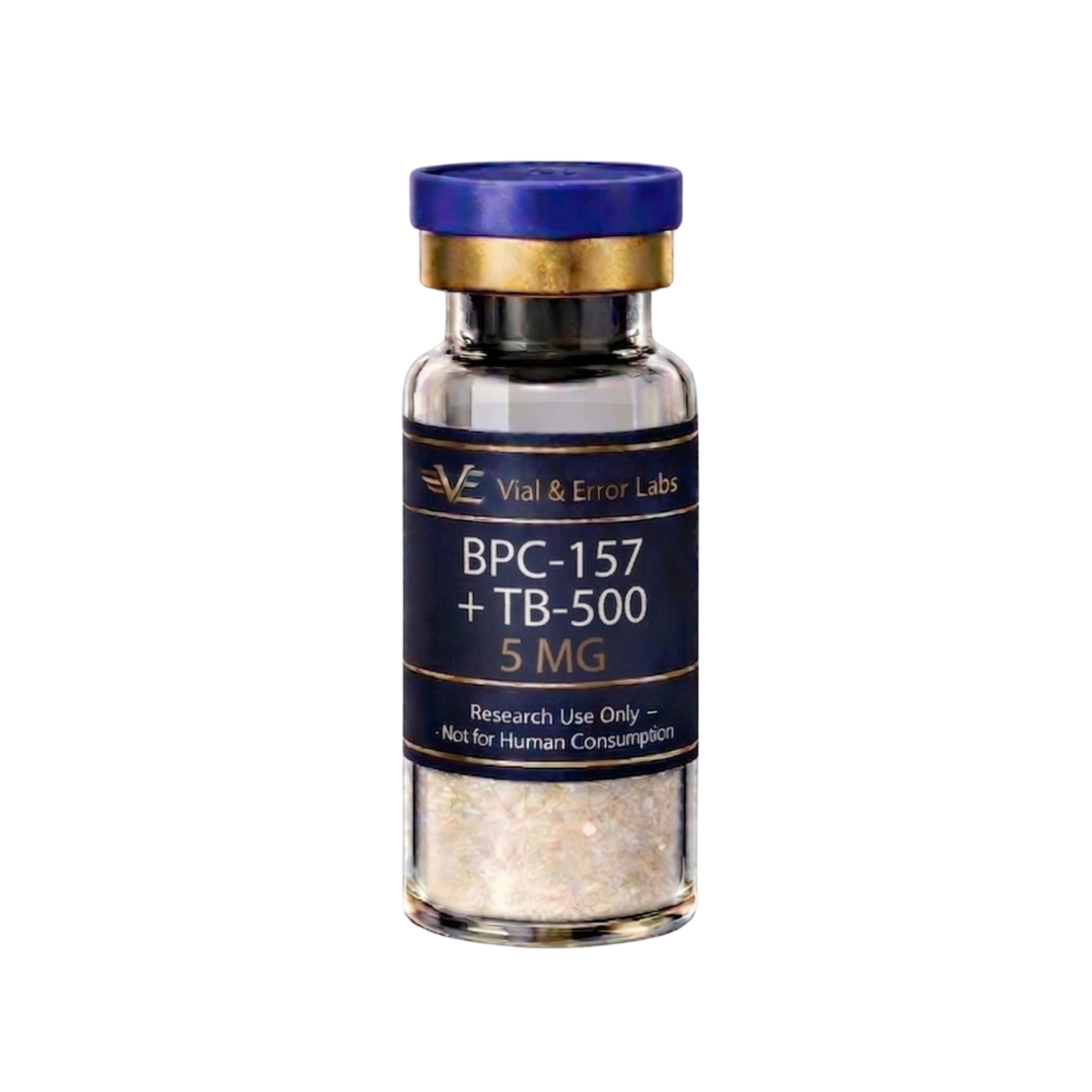
About BPC-157 + TB-500
BPC-157 + TB-500 is a dual-peptide research blend combining BPC-157 (Body Protection Compound-157, CAS 1628202-19-6) and TB-500 (Thymosin Beta-4 active fragment, CAS 77591-33-4) for controlled laboratory investigation of complementary tissue repair and angiogenesis signaling pathways. It is supplied as a lyophilized powder intended strictly for analytical and non-clinical research applications.
BPC-157 and TB-500 engage mechanistically distinct but complementary repair pathways: BPC-157 primarily modulates FAK/paxillin signaling in fibroblasts and NO-dependent VEGFR2 angiogenesis, while TB-500 (the Tβ4 active fragment LKKTETQ) regulates actin dynamics via thymosin β4-dependent G-actin sequestration and downstream VEGF-A/SDF-1 mediated endothelial cell migration. Researchers use this blend in HUVEC, dermal fibroblast, and gut epithelial models to study multi-pathway tissue integrity and repair signaling under standardized co-treatment conditions.
COMMON RESEARCH APPLICATIONS
Dual-Pathway Tissue Repair Research
Used in fibroblast scratch assays and HUVEC tube formation models to examine simultaneous BPC-157-driven FAK/paxillin signaling and TB-500-driven actin dynamics/VEGF pathway activation, characterizing additive or synergistic effects on cell migration endpoints.Angiogenesis Signaling Studies
Examined in endothelial cell models measuring VEGFR2 expression, capillary tube formation, and NO production to assess whether BPC-157 + TB-500 co-treatment produces complementary angiogenic signaling relative to each peptide alone.Gut Epithelial Barrier Research
Used in Caco-2 and IEC-6 intestinal epithelial models to study effects on tight junction protein expression (ZO-1, occludin), barrier integrity (TEER), and mucosal cytoprotection under cytokine-challenge conditions.Tendon & Musculoskeletal Signaling Models
Examined in tenocyte and myoblast cultures for complementary effects on collagen I synthesis, MMP-3 activity, and matrix remodeling gene expression, often used to characterize synergistic repair signaling profiles. -
Chemical Identity
Compound Name: BPC-157 + TB-500 blend
Synonyms: Body Protection Compound-157 / Thymosin Beta-4 fragment research blend
CAS Number: 1628202-19-6 (BPC-157) · 77591-33-4 (TB-500)
EC Number: N/A (synthetic peptide blend)
Molecular Formula: C62H98N16O22 · XC2H4O2 (BPC-157) · C212H350N56O78S (TB-500)
Molecular Weight: 1419.50 g/mol (BPC-157) · 4963.49 g/mol (TB-500)
Physical Properties
Appearance: White to off-white lyophilized powder blend
Solubility (water): ~1 mg/mL in sterile water or PBS (pH 7.4)
Solubility (organic): Limited; DMSO (~1 mg/mL with warming)
Hygroscopic: Yes — store desiccated
Quality & Testing
Purity: ≥98% each component (HPLC)/p>
Testing Method : Reverse-phase HPLC · MS confirmation · sequence verification per component
Verification
COA: Lot-specific, included with order (QR on label)
SDS Supplier : Velox Research Chemicals
SDS Revision: Current lot · OSHA HCS / GHS compliant
Handling & Storage
Storage Temperature: Store desiccated at −20°C for long-term; 2–8°C short-term. Protect from light. Refer to SDS/COA for compound-specific handling
Light Sensitivity: Protect from light
Reconstitution: Dissolve in sterile water or PBS (pH 7.4); use immediately or aliquot and store at −80°C
Available Strengths: 5 mg blend
SKU (5 mg): VE-BPC-TB500-BLEND
-
-
What is this product?
BPC-157 + TB-500 is a lyophilized research blend of BPC-157 (CAS 1628202-19-6, MW 1419.50 g/mol) and TB-500 (CAS 77591-33-4, MW 4963.49 g/mol) for controlled laboratory study of complementary tissue repair and angiogenesis signaling. For research use only.
-
What purity and testing methods are used?
Each lot is tested by reverse-phase HPLC and MS confirmation to ≥98% purity per component with sequence verification for each peptide. A lot-specific COA is included with every order, accessible via QR code on the label.
-
What are the key chemical identifiers for each component?
BPC-157: CAS 1628202-19-6 · C₆₂H₉₈N₁₆O₂₂ · MW 1419.50 g/mol. TB-500: CAS 77591-33-4 · C₂₁₂H₃₅₀N₅₆O₇₈S · MW 4963.49 g/mol. BPC-157 is a 15-AA gastric pentadecapeptide; TB-500 is the Tβ4 active heptapeptide fragment LKKTETQ.
-
How is this blend reconstituted for research use?
Dissolve in sterile water or PBS (pH 7.4) at ~1 mg/mL. Use immediately or aliquot and store at −80°C. Avoid repeated freeze-thaw cycles. Protect from light.
-
What is the recommended storage upon receipt?
Store immediately at −20°C desiccated. For long-term stability, −80°C is preferred. Short-term at 2–8°C is acceptable for up to 2 weeks. Inspect vials for integrity upon receipt.
-
What is a COA and why does it matter?
A COA documents lot-specific purity per component (HPLC ≥98%), sequence verification (MS), and appearance. Each lot ships with a QR-accessible COA. Review before use to confirm both peptides meet your experimental requirements.
-
What is this product?
Reviews
There are no reviews yet.