


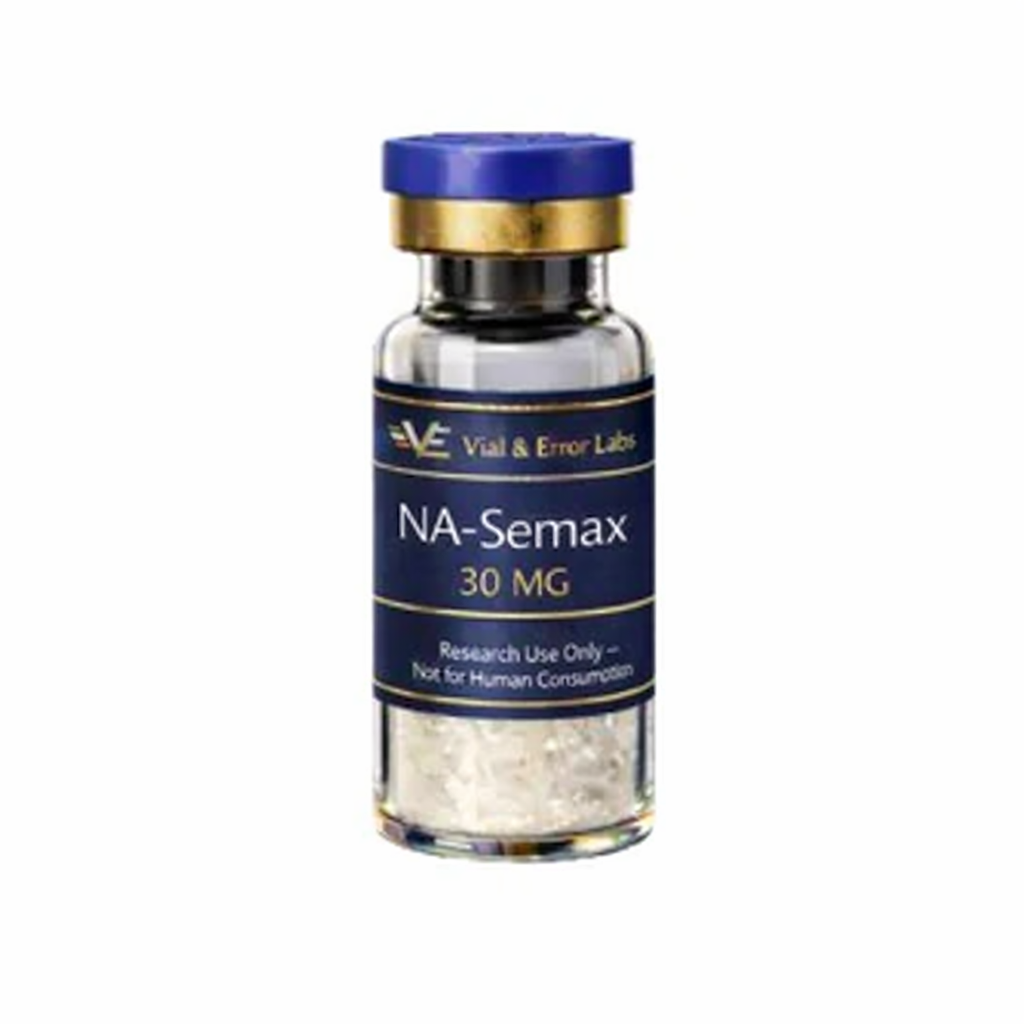
Description
-
About NA Semax amidate
N-Acetyl Semax Amidate (CAS 2920938-90-3) is a doubly-stabilized synthetic derivative of Semax (Met-Glu-His-Phe-Pro-Gly-Pro, MEHFPGP) — a heptapeptide ACTH(4-7)-PGP analog developed at the Institute of Molecular Genetics of the Russian Academy of Sciences — incorporating N-terminal acetylation and C-terminal amidation for enhanced enzymatic stability and BBB penetration. It is supplied as a laboratory-grade lyophilized powder intended strictly for analytical and non-clinical research applications.
Semax was originally developed as a synthetic analog of ACTH(4-7) with a C-terminal Pro-Gly-Pro extension that stabilizes the core MEHF pharmacophore. The acetyl-amidate modifications further extend half-life by shielding both termini from exopeptidase cleavage. N-Acetyl Semax Amidate has been characterized for BDNF/TrkB pathway upregulation in hippocampal models, serotonin and dopamine pathway modulation, Nrf2-mediated oxidative stress response, and melanocortin MC4/MC5 receptor interaction. Researchers use this compound in SH-SY5Y, primary cortical/hippocampal neurons, and vascular endothelial models as a stabilized probe for neuroprotective signaling, BDNF-driven synaptic plasticity, and comparative pharmacology versus unmodified Semax.
BDNF/TrkB Neuroprotective Signaling
N-Acetyl Semax Amidate is examined in SH-SY5Y, primary hippocampal neurons, and cortical models under oxidative or excitotoxic challenge to study BDNF expression, TrkB/CREB phosphorylation, MAPK/ERK pathway activation, and neuroprotective gene expression endpoints.Neurotransmitter System Modulation Studies
Used in primary neuronal models and brain slice preparations to characterize serotonin turnover, dopamine release, and serotonin transporter (SERT) expression changes as markers of monoaminergic pathway modulation downstream of ACTH analog receptor interaction.Neuroprotection Under Ischemic & Oxidative Stress
Used in OGD (oxygen-glucose deprivation), H₂O₂ challenge, and rotenone-induced mitochondrial stress models to study Nrf2/HO-1 pathway activation, mitochondrial membrane potential (ΔΨm) maintenance, and cell viability endpoint characterization.Comparative Semax Form Benchmarking
Reference stabilized form for paired studies alongside unmodified Semax to characterize the effect of N-acetylation and C-terminal amidation on half-life, BDNF response magnitude, Met oxidation susceptibility, and BBB penetration in pharmacokinetic and signaling assays.Chemical Identity
Compound Name: NA Semax amidate
Internal Catalog Code: NA Semax amidate
CAS Number:
Molecular Formula: C₃₉H₅₃N₉O₁₁S
Molecular Weight: 855.97 g/mol
Physical Properties
Form/Appearance: Lyophilized powder
Quality & Testing
Purity: As listed on lot-specific COA
Testing Method : HPLC (as applicable) · identity confirmation per COA
Verification
COA: Lot-specific, included with order (QR on label)
Handling & Storage
Storage Temperature: Store desiccated at −20°C for long-term; 2–8°C short-term. Protect from light. Refer to SDS/COA for compound-specific handling.
Light Sensitivity: Protect from light
Moisture: Store desiccated when applicable
Available Strengths: 30 mg
SKU (30 mg): VE-NASE-030X
-
What is this product?
N-Acetyl Semax Amidate (CAS 2920938-90-3, MW 855.97 g/mol, C₃₉H₅₃N₉O₁₁S) is supplied as a lyophilized doubly-stabilized Semax derivative (Ac-Met-Glu-His-Phe-Pro-Gly-Pro-NH₂) for laboratory research use only. Available as VE-NASE-030X (30 mg).
-
What purity and testing methods are used?
Each lot is tested by reverse-phase HPLC and MS confirmation to ≥98% purity with sequence and modification verification (N-Ac and C-amide confirmed). A lot-specific COA is included with every order, accessible via QR code on the label.
-
What are the key chemical identifiers?
CAS 2920938-90-3 · Molecular formula C₃₉H₅₃N₉O₁₁S · MW 855.97 g/mol · Sequence: Ac-Met-Glu-His-Phe-Pro-Gly-Pro-NH₂ · Synonyms: N-Ac Semax amidate, acetylated-amidated Semax, stabilized ACTH(4-7)-PGP analog.
-
How is N-Acetyl Semax Amidate reconstituted for research use?
Dissolve in sterile water or PBS (pH 7.0) at ~5 mg/mL. The Met residue is susceptible to oxidation — use deoxygenated water when possible, and minimize air exposure during handling. Aliquot and store at −80°C. Protect from light and air.
-
What is the recommended storage upon receipt?
Store immediately at −20°C desiccated. For extended stability (Met oxidation protection), −80°C is preferred. Short-term 2–8°C acceptable for up to 1 week. Inspect vials upon receipt and note any discoloration which may indicate Met oxidation.
-
What is a COA and why does it matter?
A COA documents lot-specific purity (HPLC ≥98%), MS identity, and modification verification. For Met-containing peptides, confirming Met is in the reduced (unoxidized) form is critical for receptor binding studies. Each lot ships with a QR-accessible COA. Review before use, specifically checking the oxidized Met peak in the HPLC trace.
Reviews
There are no reviews yet.