


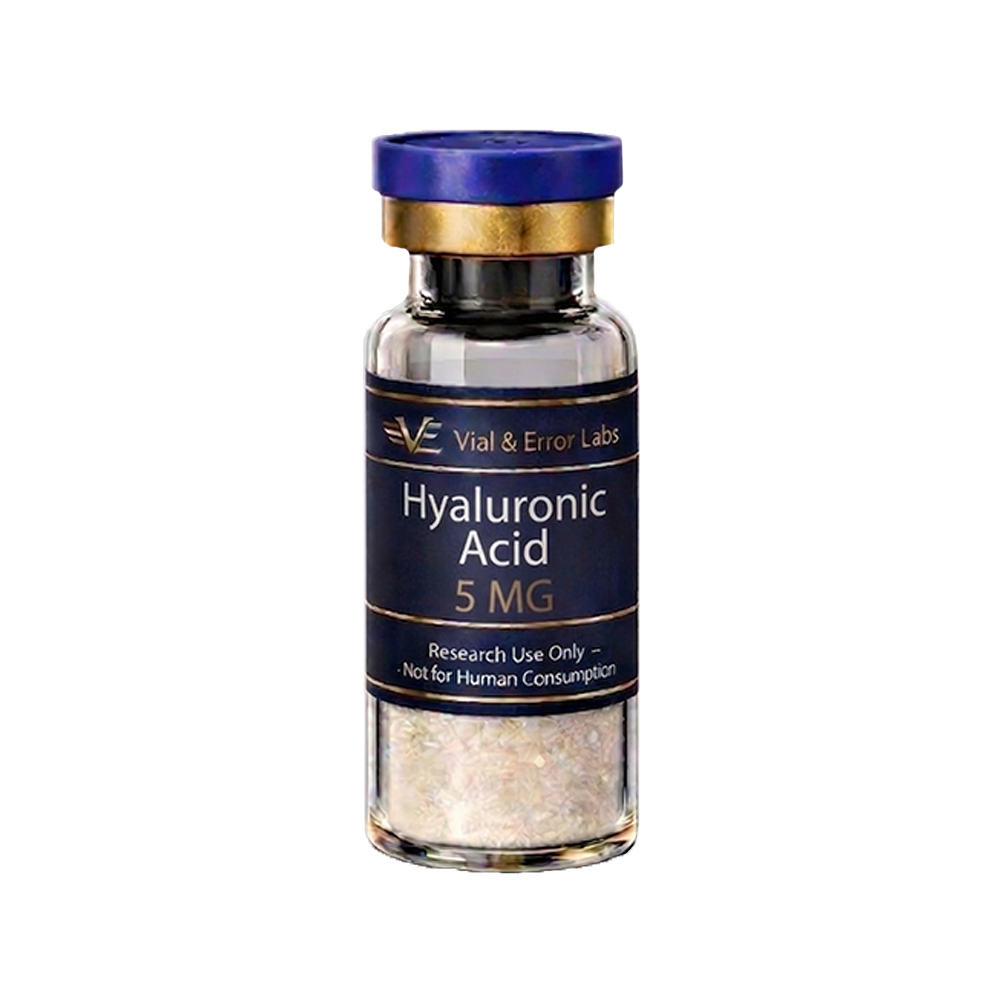
Description
-
About Hyaluronic Acid
Hyaluronic acid (hyaluronan, HA, CAS 9004-61-9) is a high-molecular-weight non-sulfated glycosaminoglycan (GAG) polymer composed of repeating disaccharide units of D-glucuronic acid and N-acetyl-D-glucosamine, linked by alternating β-1,3 and β-1,4 glycosidic bonds. As a major component of the extracellular matrix (ECM), pericellular coat, and synovial fluid, hyaluronic acid is one of the most important structural and signaling biomolecules in connective tissue biology. It is supplied as a laboratory-grade lyophilized material intended strictly for analytical and non-clinical research applications.
AHA signals through cell-surface receptors CD44 and RHAMM/HMMR, activating PI3K/Akt, Ras/MAPK/ERK, and Rho/ROCK signaling pathways in a molecular-weight-dependent manner: high-MW HA (>500 kDa) is generally anti-inflammatory and tissue-protective, while low-MW HA fragments (<200 kDa) are pro-inflammatory (TLR2/TLR4-dependent). This MW-dependent signaling polarity makes HA a uniquely nuanced ECM research tool. Researchers use HA in fibroblast, chondrocyte, cancer cell, and wound healing models to study CD44/RHAMM receptor pharmacology, EMT (epithelial-mesenchymal transition) pathway activation, viscoelastic hydrogel scaffold development, and biomaterial-cell interaction studies.
COMMON RESEARCH APPLICATIONS
CD44/RHAMM Receptor Signaling Research
Hyaluronic acid is the reference CD44 ligand used in CD44-expressing cancer cell lines (MDA-MB-231, A549) and primary fibroblast models to study PI3K/Akt, Ras/MAPK/ERK, and Rho/ROCK pathway activation; MW-dependent signaling polarity (high-MW anti-inflammatory vs. low-MW pro-inflammatory) is explicitly examined.EMT & Cancer Cell Migration Assays
Used in Transwell migration, Matrigel invasion, and scratch wound assays with CD44-high cancer cell lines to study CD44-mediated EMT pathway activation (vimentin, N-cadherin, Snail/Slug expression) and HA-driven cell motility as a function of polymer molecular weight.Viscoelastic Hydrogel Scaffold Development
Used as the primary biopolymer in HA hydrogel formulation studies; crosslinking chemistry (methacrylate, thiol-ene, NHS-ester), gelation kinetics, mechanical property characterization (rheology, stiffness), and cell encapsulation viability are studied as biomaterial performance endpoints.Molecular Weight–Dependent Signaling Characterization
High-MW HA (>500 kDa) and low-MW HA fragments (<200 kDa) are studied in parallel in THP-1 macrophage and PBMC models to characterize TLR2/TLR4 vs. CD44 pathway engagement, NF-κB activation polarity, and cytokine secretion profiles as a function of fragment size. -
Chemical Identity
Compound Name: Hyaluronic Acid
Internal Catalog Code: Hyaluronic Acid
CAS Number: 9004-61-9
Molecular Formula: (C14H21NO11)n
Molecular Weight: Polymer (variable)
Physical Properties
Form/Appearance: Lyophilized powder
Quality & Testing
Purity: As listed on lot-specific COA
Testing Method : HPLC (as applicable) · identity confirmation per COA
Verification
COA: Lot-specific, included with order (QR on label)
Handling & Storage
Storage Temperature: Store desiccated at −20°C for long-term; 2–8°C short-term. Protect from light. Refer to SDS/COA for compound-specific handling.
Light Sensitivity: Protect from light
Moisture: Store desiccated when applicable
Available Strengths: 5 mg
SKU (5 mg): VE-HYAL-005
-
-
What is this product?
Hyaluronic acid (hyaluronan, CAS 9004-61-9, polymer: (C₁₄H₂₁NO₁₁)n) is supplied as a lyophilized non-sulfated glycosaminoglycan polymer for laboratory research use only. It is the reference ECM biopolymer for CD44/RHAMM receptor signaling and biomaterial scaffold research. Available as VE-HYAL-005 (5 mg).
-
What purity and testing methods are used?
Each lot is characterized by HPLC (to confirm polymer integrity), identity confirmation, and molecular weight range verification. A lot-specific COA documenting molecular weight distribution, identity, and preparation is included with every order, accessible via QR code on the label.
-
What are the key chemical identifiers?
CAS 9004-61-9 · Repeating unit formula (C₁₄H₂₁NO₁₁)n · MW: Polymer (variable; lot-specific range on COA) · Synonyms: hyaluronan, HA, sodium hyaluronate (Na salt form), GAG, CD44 ligand, RHAMM ligand.
-
Why does molecular weight matter for HA in research applications?
HA exhibits fundamentally different biological activities depending on molecular weight: high-MW HA (>500 kDa) is anti-inflammatory, promotes tissue homeostasis, and signals through CD44 to suppress pro-inflammatory pathways (NF-κB). Low-MW HA fragments (≤200 kDa, generated during inflammation/tissue damage) are pro-inflammatory, signaling through TLR2/TLR4 and CD44/RHAMM. Always confirm the lot-specific MW range from the COA before designing experiments — this is the single most important parameter for interpreting HA signaling studies.
-
What is the recommended storage upon receipt?
Store at −20°C desiccated. Once reconstituted, store at 4°C for up to 1 week or −20°C aliquoted for longer periods. High-MW HA is susceptible to mechanical shear degradation — pipette gently using wide-bore tips. Inspect upon receipt for caking or discoloration.
-
What is a COA and why does it matter?
A COA documents lot-specific molecular weight range (critical for biological activity), identity, and purity. For HA, the MW distribution is the defining quality parameter — it determines whether the material signals as an anti-inflammatory (high-MW) or pro-inflammatory (low-MW) agent. Each lot ships with a QR-accessible COA. Always review the MW range before use.
-
What is this product?
Reviews
There are no reviews yet.