


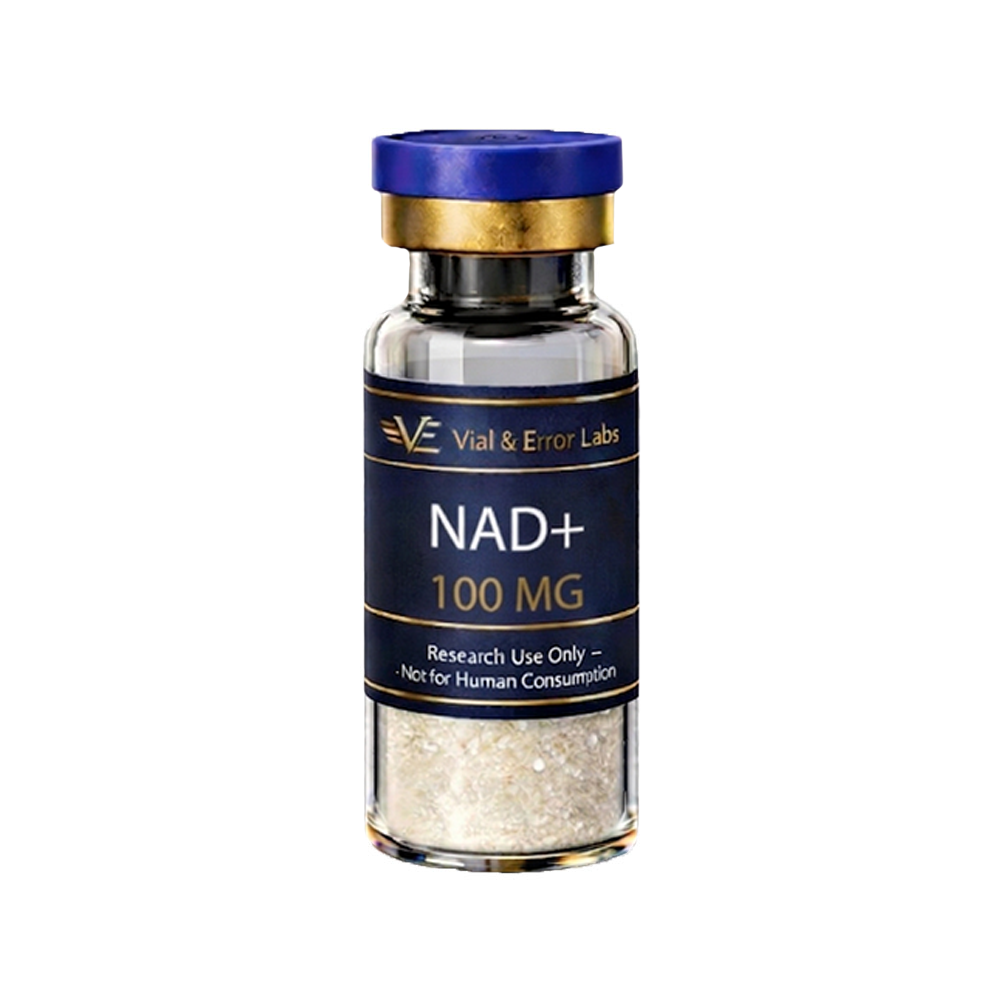
Description
-
About NAD⁺ (Nicotinamide Adenine Dinucleotide)
NAD⁺ — nicotinamide adenine dinucleotide (CAS 53-84-9) — is the oxidized form of the essential pyridine nucleotide coenzyme that mediates electron transfer in cellular metabolism. It functions as a hydride acceptor in glycolysis, the citric acid cycle, and fatty acid β-oxidation, and as a substrate for three major enzyme classes: sirtuins (SIRT1–7, NAD⁺-dependent deacylases), PARPs (poly-ADP-ribose polymerases, DNA damage response), and CD38/CD157 (NAD⁺ glycohydrolases).
Intracellular NAD⁺ levels decline with age, caloric excess, and inflammation — a finding central to the biology of metabolic dysfunction and cellular aging. As a research tool, NAD⁺ is used to study redox metabolism, sirtuin-mediated gene regulation, PARP-dependent DNA repair, and the broader NAD⁺ metabolome. Supplied as a lyophilized free acid for analytical and non-clinical research use only.
COMMON RESEARCH APPLICATIONS
Sirtuin (SIRT1–7) Activity Assays
NAD⁺ is the obligate co-substrate for all 7 sirtuin deacylases. Used in SIRT1 fluorescence deacetylase assays and SIRT3 mitochondrial deacetylation studies; benchmark substrate at physiological (100–500 μM) and supraphysiological concentrations.PARP-1/2 DNA Repair Research
PARP enzymes consume NAD⁺ to synthesize poly-ADP-ribose (PAR) chains at DNA damage sites. Used in genotoxic stress models (H₂O₂, UV, alkylating agents) to study NAD⁺ consumption kinetics and PARP-dependent cell death vs. survival thresholds.Redox Metabolism & NAD⁺/NADH Ratio Studies
Used in cycling assays to quantify NAD⁺/NADH ratios as metabolic state indicators in glycolysis-dominant vs. OXPHOS-dominant conditions; standard substrate in luminescent NAD⁺/NADH quantification kits (Promega, Abcam).NAD⁺ Biosynthesis Pathway Research
External NAD⁺ used to study salvage pathway components (NAMPT, NMNAT1-3) and de novo synthesis (QPRT) under NAD⁺-depletion conditions; used alongside NMN and NR as comparator NAD⁺ precursors in supplementation pathway studies. -
Chemical Identity
Compound Name: NAD⁺
Synonyms: Nicotinamide adenine dinucleotide · β-Nicotinamide adenine dinucleotide · coenzyme I · DPN · NAD free acid
CAS Number: 53-84-9
EC Number: 200-184-4
Molecular Formula: C₂₁H₂₇N₇O₁₄P₂
Molecular Weight: 663.43 g/mol
Physical Properties
Appearance: White to off-white lyophilized powder
Solubility (water): ~20 mg/mL in sterile water (pH 6–7); stable at acidic pH
Solubility (organic): Insoluble in ethanol, DMSO
Hygroscopic: Yes — store desiccated; highly sensitive to moisture
Quality & Testing
Purity: ≥98% (HPLC)
Testing Method : Reverse-phase HPLC · enzymatic cycling assay · UV absorbance (260 nm)
Verification
COA: Lot-specific, included with order (QR on label)
SDS Supplier : See SDS/MSDS · OSHA HCS / GHS compliant · Sigma-Aldrich grade equivalent
Handling & Storage
Storage Temperature: Store desiccated at −20°C long-term. Protect from light and moisture. NAD⁺ degrades rapidly at neutral to alkaline pH at room temperature.
Light Sensitivity: Protect from light (UV-sensitive)
Reconstitution: Dissolve in sterile water at ~20 mg/mL, pH adjusted to 6–7. Prepare fresh solutions; avoid neutral/alkaline pH during storage
Available Strengths: 100 mg · 500 mg · 1000mg
SKU (100 mg): VE-NAD-100
SKU (500 mg): VE-NAD-500
SKU (1000 mg): VE-NAD-1000
-
-
What is this product?
NAD⁺ (β-nicotinamide adenine dinucleotide, free acid) is supplied as a lyophilized coenzyme (CAS 53-84-9, MW 663.43 g/mol) for laboratory research use only. It is the oxidized form of the essential pyridine nucleotide involved in cellular redox reactions, sirtuin activity, and PARP-mediated DNA repair.
-
What purity and testing methods are used?
Each lot is tested by reverse-phase HPLC and enzymatic cycling assay to ≥98% purity with UV absorbance verification at 260 nm. A lot-specific COA is included with every order, accessible via QR code on the label.
-
What are the key chemical identifiers?
CAS 53-84-9 · EC Number 200-184-4 · Molecular formula C₂₁H₂₇N₇O₁₄P₂ · MW 663.43 g/mol · Synonyms: nicotinamide adenine dinucleotide, coenzyme I, DPN, β-NAD free acid.
-
How is NAD⁺ reconstituted for research use?
Dissolve in sterile water at ~20 mg/mL, then adjust pH to 6–7. NAD⁺ is unstable at neutral to alkaline pH at room temperature — prepare fresh solutions and use immediately or store aliquots at −80°C. DMSO and ethanol are not suitable solvents. Protect from light.
-
What is the difference between NAD⁺, NMN, and NR in research applications?
NAD⁺ is the final oxidized coenzyme; NMN (nicotinamide mononucleotide) and NR (nicotinamide riboside) are NAD⁺ precursors that enter the salvage biosynthesis pathway. NAD⁺ itself is used for direct enzymatic assays (sirtuin, PARP), while NMN and NR are used in precursor supplementation and salvage pathway studies.
-
What is the recommended storage upon receipt?
Store immediately at −20°C in a desiccated environment. NAD⁺ is highly hygroscopic and UV-sensitive. Do not leave at room temperature. Inspect for color (should be white to off-white) upon receipt.
-
What is a COA and why does it matter?
A COA documents lot-specific purity (HPLC ≥98%), enzymatic activity, and identity. NAD⁺ lots should be verified for both chemical purity and functional enzyme-coupling activity. Each lot ships with a QR-accessible COA. Review before use.
-
What is this product?
Reviews
There are no reviews yet.