

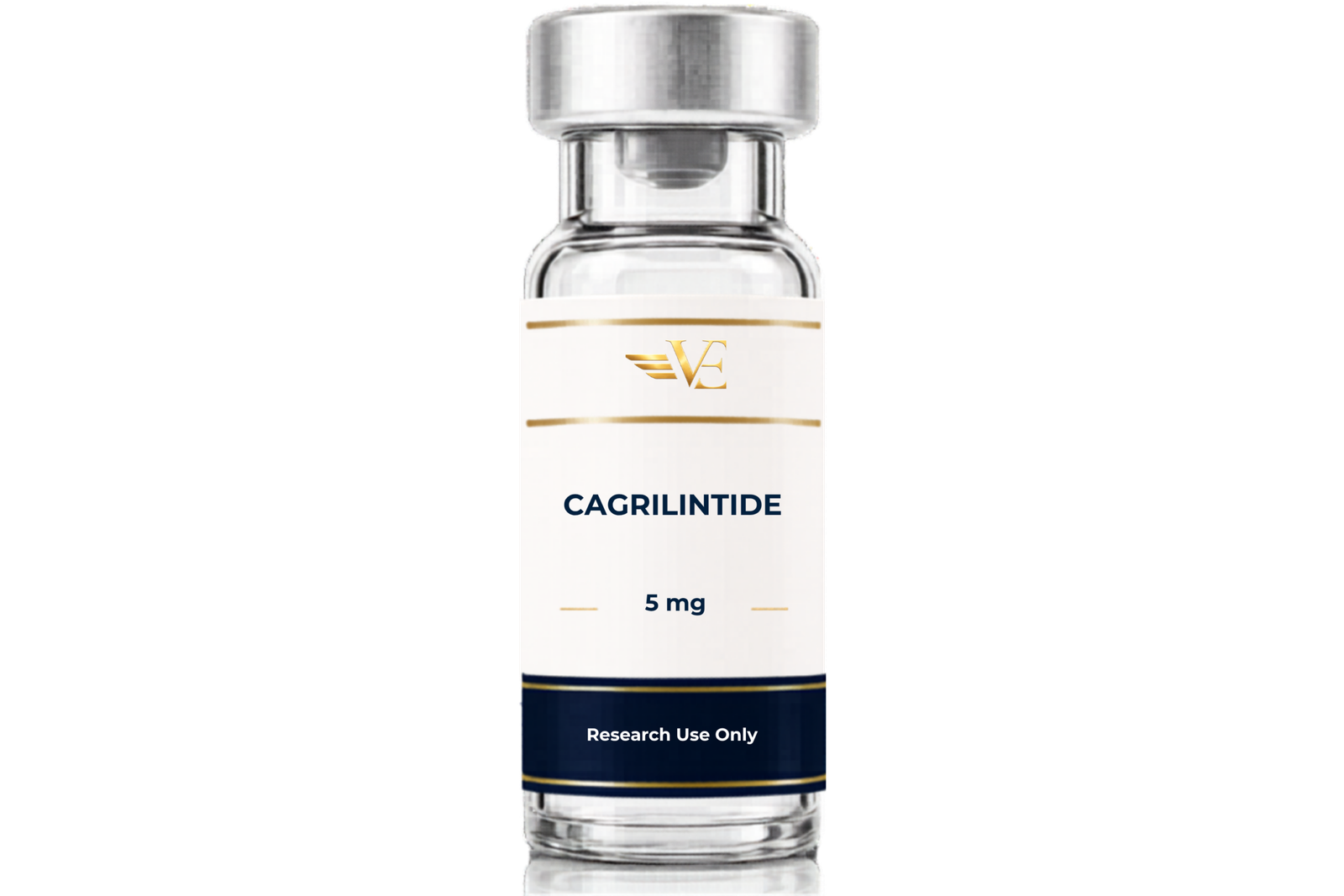
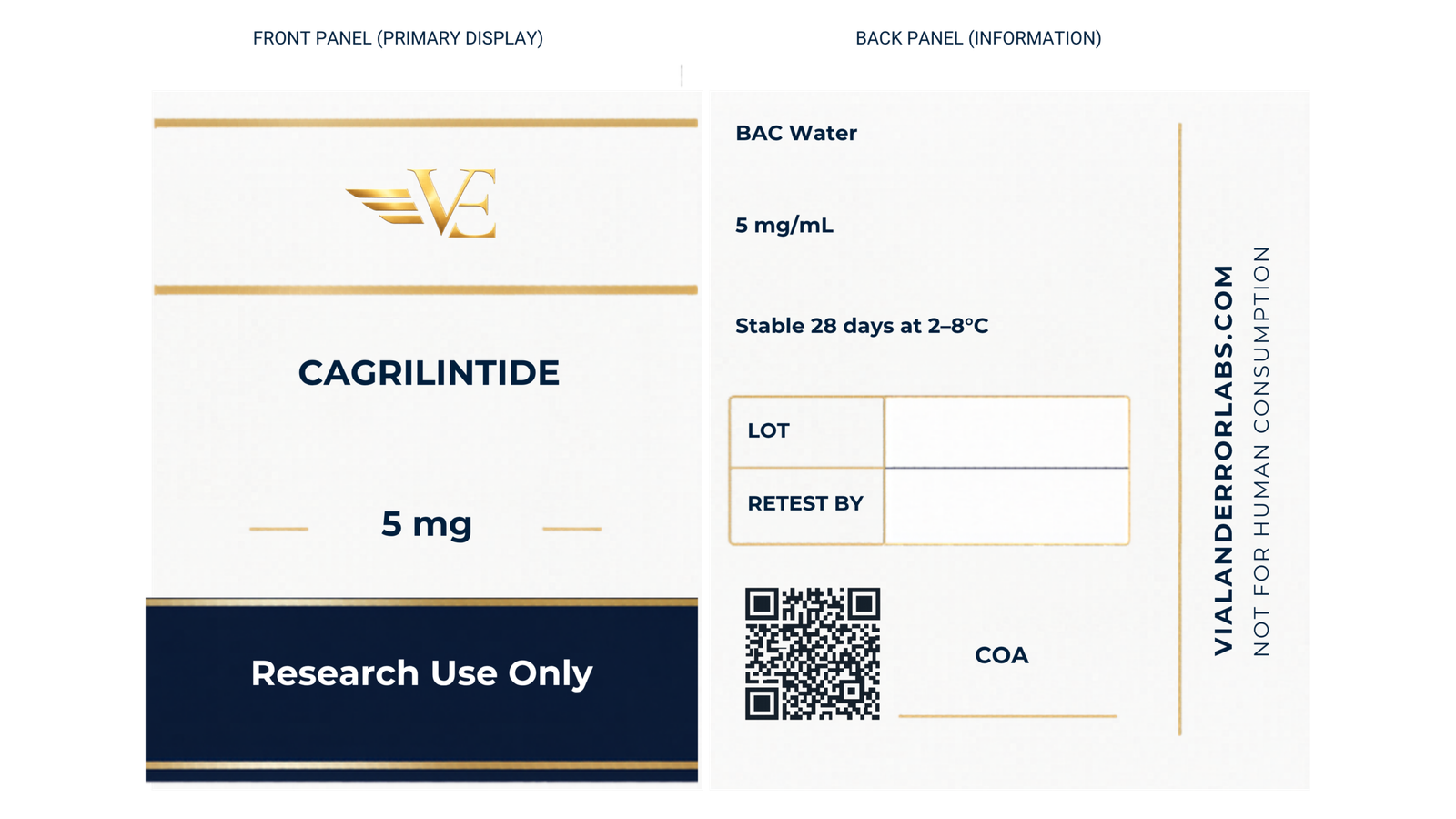
Description
-
About Cagrilintide
Cagrilintide — also known as AM833 (CAS 2381254-99-3) — is a long-acting synthetic amylin analog developed by Novo Nordisk with a C18 fatty diacid chain enabling albumin binding and an extended half-life (~7 days) suitable for once-weekly dosing. It is supplied as a laboratory-grade lyophilized powder intended strictly for analytical and non-clinical research applications.
Amylin (IAPP) is co-secreted with insulin by pancreatic β-cells and acts on amylin receptors (AMYRs: CTR + RAMP1/2/3 complexes) in the brainstem area postrema and hypothalamic arcuate nucleus to reduce food intake, slow gastric emptying, and suppress glucagon secretion. Cagrilintide was designed as a metabolically stable amylin analog for once-weekly administration, and is being investigated in combination with semaglutide (CagriSema) for additive weight loss through complementary GLP-1R and AMYR mechanisms. Researchers use cagrilintide in area postrema/NTS neuronal models, hypothalamic arcuate nucleus cell lines, and β-cell co-secretion models to study AMYR pharmacology, appetite suppression circuit signaling (POMC/AgRP axis), gastric emptying pathway markers, and amylin/GLP-1 combinatorial receptor co-activation.
COMMON RESEARCH APPLICATIONS
Amylin Receptor (AMYR) Pharmacology
Cagrilintide is used in SH-SY5Y, CTR-expressing HEK293, and area postrema neuronal models to study AMYR (CTR + RAMP1/2/3 complex) activation kinetics, cAMP/PKA signaling, and receptor internalization under once-weekly dosing simulation conditions.Appetite Circuit & Hypothalamic Satiety Signaling
Used in NPY/AgRP and POMC neuron models and hypothalamic slice preparations to study AMYR-driven appetite suppression pathway activation, POMC/α-MSH induction, AgRP suppression, and gastric emptying pathway markers in the arcuate nucleus.CagriSema Combination Pharmacology Research
Used alongside semaglutide in GLP-1R/AMYR co-stimulation studies in pancreatic β-cell, hypothalamic neuron, and hepatocyte models to characterize additive vs. synergistic effects on cAMP accumulation, insulin secretion, lipid oxidation, and appetite pathway markers.Comparative Long-Acting Amylin Analog Benchmarking
Reference compound for comparing once-weekly AMYR agonism pharmacology against pramlintide (short-acting AMYR, 3 h half-life) and native IAPP in receptor binding assays, cAMP dose-response studies, and amyloid fibril formation risk characterization. -
Chemical Identity
Compound Name: Cagrilintide
Internal Catalog Code: Cagrilintide
CAS Number: 2381254-99-3
Molecular Formula: C167H265N47O50S2
Molecular Weight: 3804.27 g/mol
Physical Properties
Form/Appearance: Lyophilized powder
Quality & Testing
Purity: As listed on lot-specific COA
Testing Method : HPLC (as applicable) · identity confirmation per COA
Verification
COA: Lot-specific, included with order (QR on label)
Handling & Storage
Storage Temperature: Store desiccated at −20°C for long-term; 2–8°C short-term. Protect from light. Refer to SDS/COA for compound-specific handling.
Light Sensitivity: Protect from light
Moisture: Store desiccated when applicable
Available Strengths: 5 mg · 10 mg · 20 mg
SKU (5 mg): VE-CAGR-005
SKU (10 mg): VE-CAGR-010
SKU (20 mg): VE-CAGR-020
-
-
What is this product?
Cagrilintide (AM833, CAS 2381254-99-3, MW 3804.27 g/mol, C₁₆₇H₂₆₅N₄₇O₅₀S₂) is supplied as a lyophilized long-acting amylin receptor agonist for laboratory research use only. Available as VE-CAGR-005 (5 mg), VE-CAGR-010 (10 mg), and VE-CAGR-020 (20 mg).
-
What purity and testing methods are used?
Each lot is tested by reverse-phase HPLC and MS confirmation to ≥98% purity with sequence verification. A lot-specific COA is included with every order, accessible via QR code on the label.
-
What are the key chemical identifiers?
CAS 2381254-99-3 · Molecular formula C₁₆₇H₂₆₅N₄₇O₅₀S₂ · MW 3804.27 g/mol · Synonyms: AM833, long-acting amylin analog, AMYR agonist, CagriSema component (with semaglutide).
-
How does cagrilintide differ from native amylin (pramlintide) in receptor pharmacology research?
Native amylin (IAPP) and pramlintide are short-acting AMYR agonists (half-life ~3 h for pramlintide). Cagrilintide extends half-life to ~7 days via C18 fatty diacid-mediated albumin binding — enabling once-weekly dosing simulation in research models. Cagrilintide also has engineered amino acid substitutions that prevent amyloid fibril formation (a key limitation of native IAPP). Use pramlintide for acute AMYR pharmacology studies; use cagrilintide for chronic or pharmacokinetic AMYR models and CagriSema combination studies.
-
How is cagrilintide reconstituted for research use?
Dissolve in sterile water or PBS (pH 7.4) at ~1 mg/mL. Avoid repeated freeze-thaw cycles. Store desiccated at −20°C long-term. Protect from light.
-
What is the recommended storage upon receipt?
Store immediately at −20°C desiccated. Short-term 2–8°C acceptable. Inspect vials for integrity upon receipt.
-
What is a COA and why does it matter?
A COA documents lot-specific purity (HPLC ≥98%), identity (MS), and sequence verification. Each cagrilintide lot ships with a QR-accessible COA. Review before use to confirm identity and purity — particularly important for amylin receptor pharmacology studies where amyloid formation must be excluded.
-
What is this product?
-
PubMed Literature Search — cagrilintide
Primary literature · curated search
Open PubMedPubChem Compound Record
Full chemical data, bioassays, patents
View RecordSource Document / Insert
Supplier insert or supporting SDS source
Download PDF