

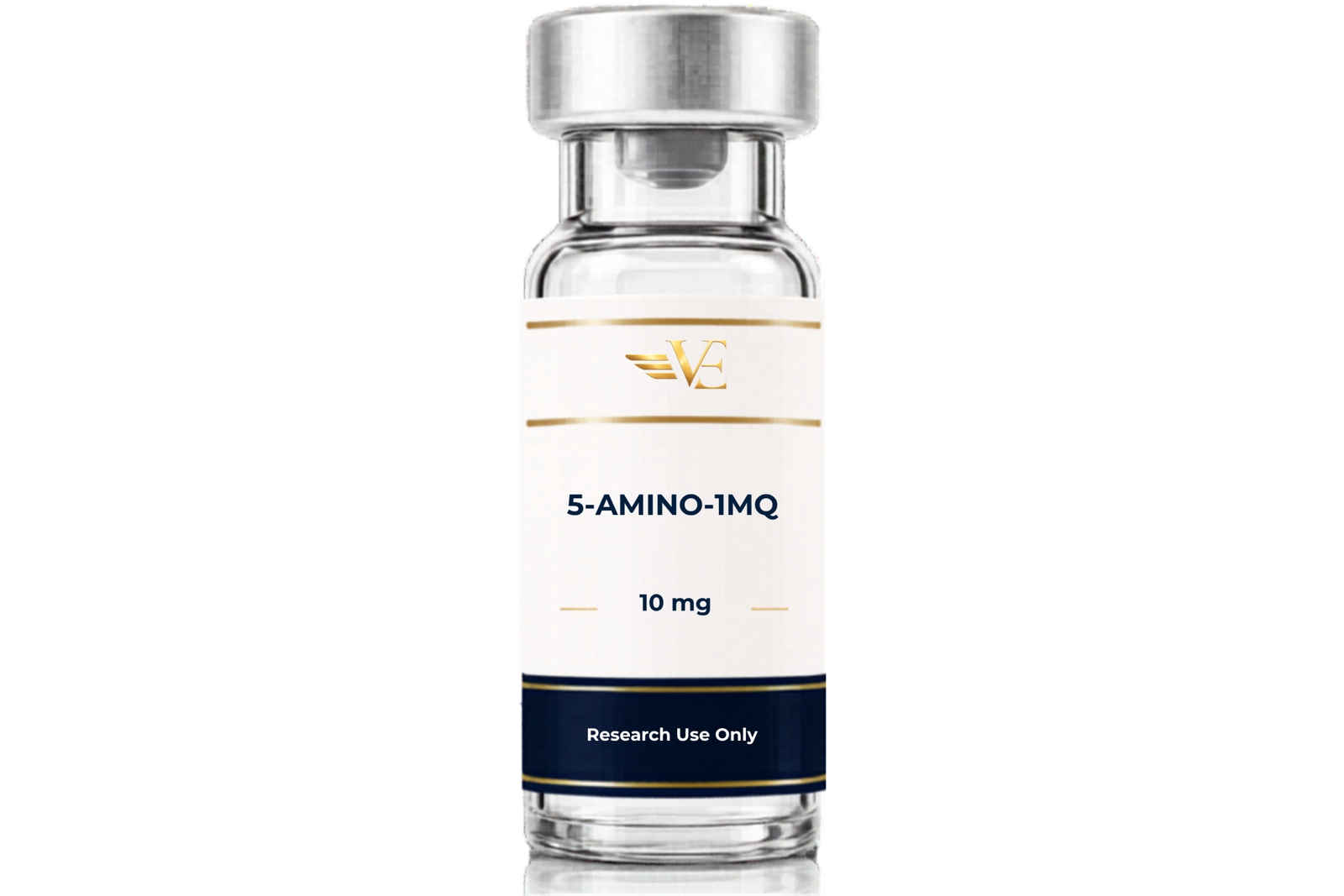
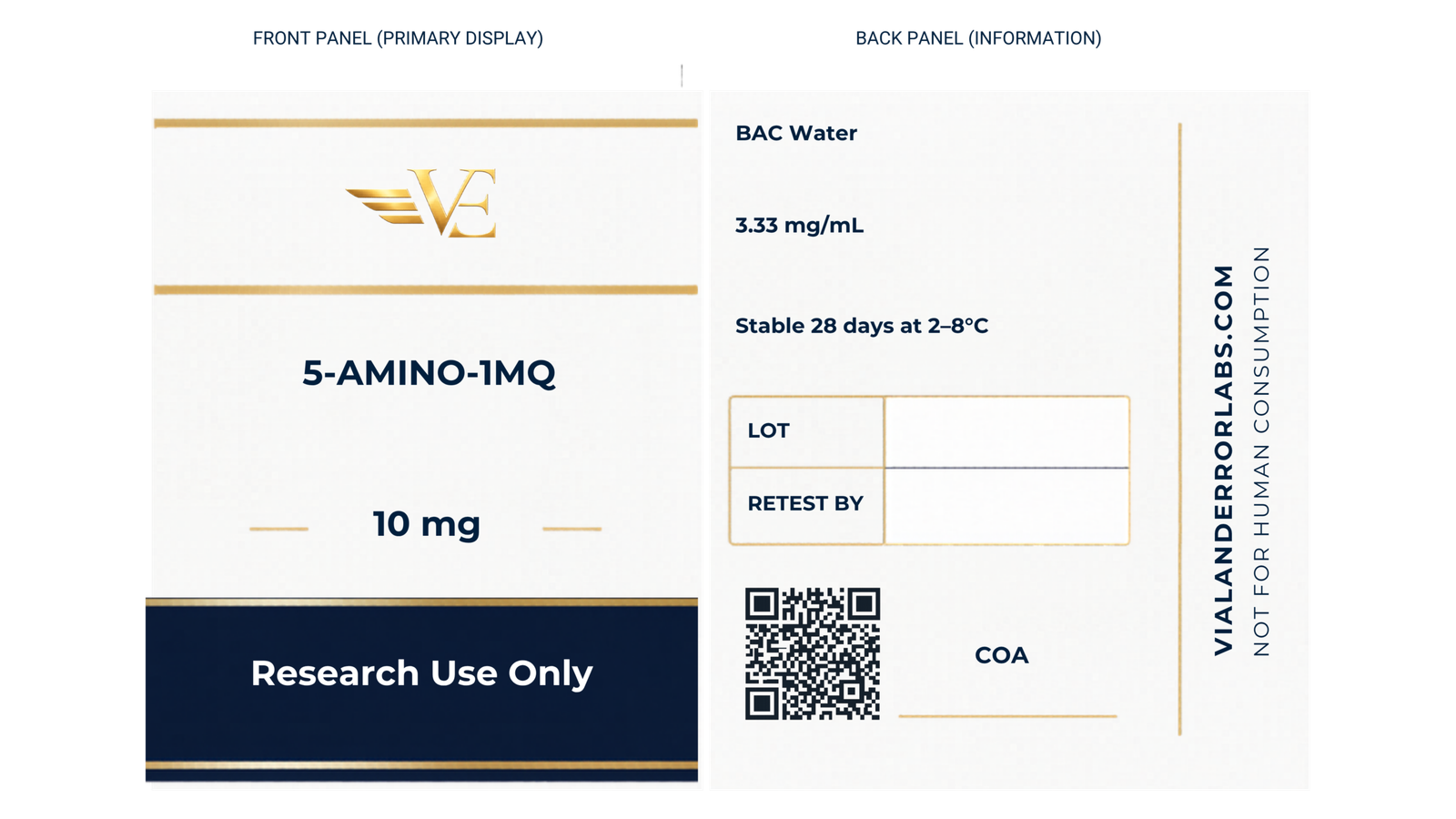
Description
-
5-Amino-1MQ
5-Amino-1MQ — 5-amino-1-methylquinolinium (CAS 5765-44-6) — is a cell-permeable small-molecule inhibitor of nicotinamide N-methyltransferase (NNMT), an enzyme that catalyzes the N-methylation of nicotinamide using S-adenosylmethionine (SAM) as the methyl donor. It is supplied as a laboratory-grade crystalline solid intended strictly for analytical and non-clinical research applications.
NNMT sits at the intersection of NAD⁺ precursor metabolism and one-carbon/methyl-donor flux. By inhibiting NNMT, 5-Amino-1MQ increases cellular nicotinamide availability for NAD⁺ biosynthesis while reducing SAM consumption, shifting the methylation and bioenergetics balance in metabolically active cells. Researchers use 5-Amino-1MQ in adipocyte, hepatocyte, and skeletal muscle cell models to examine NNMT-dependent regulation of lipid storage, adipogenesis transcription programs, and mitochondrial bioenergetic capacity.
COMMON RESEARCH APPLICATIONS
NNMT Inhibition & NAD⁺ Precursor Flux Studies
5-Amino-1MQ is used in cell-based assays to quantify NNMT enzymatic inhibition, changes in intracellular nicotinamide and NAD⁺ levels, and downstream shifts in NAD⁺-dependent enzyme activity (sirtuins, PARP) in metabolically active cell lines.Adipogenesis & Lipid Metabolism Models
Applied in 3T3-L1 and primary preadipocyte differentiation models to examine NNMT's role in adipogenic transcription factor regulation (PPARγ, C/EBPα), lipid droplet accumulation, and lipolytic enzyme activity under NNMT-inhibited conditions.One-Carbon Metabolism & SAM Axis Research
Used in hepatocyte and metabolic cell models to study NNMT-dependent SAM consumption, methyl-donor pool availability, and downstream effects on methylation-sensitive gene expression and epigenetic regulation.Metabolic Energy Expenditure Assays
Examined in skeletal muscle and brown adipocyte models to assess NNMT inhibition effects on mitochondrial oxygen consumption rate (OCR), uncoupling protein expression, and cellular ATP turnover as markers of metabolic rate modulation. -
Chemical Identity
Compound Name: 5-Amino-1MQ
Synonyms: 5-Amino-1-methylquinolinium iodide · 5-Amino-1-methylquinolinium · NNMT inhibitor 5-Amino-1MQ
CAS Number: 5765-44-6
EC Number: N/A (synthetic small molecule)
Molecular Formula: C₁₀H₁₁IN₂
Molecular Weight: 286.11 g/mol
Physical Properties
Appearance: Yellow to amber crystalline powder
Solubility (water): Soluble in water; ~10 mg/mL
Solubility (organic): Soluble in DMSO
Hygroscopic: Yes — store desiccated
Quality & Testing
Purity: ≥98% (HPLC)
Testing Method: Reverse-phase HPLC · MS confirmation of molecular identity
Verification
COA: Lot-specific, included with order (QR on label)
SDS Revision: Current lot · OSHA HCS / GHS compliant
Handling & Storage
Storage Temperature: Store desiccated at −20°C for long-term; 2–8°C short-term. Protect from light. Refer to SDS/COA for compound-specific handling
Light Sensitivity: Protect from light — photosensitive quinolinium compound
Reconstitution: Dissolve in sterile water or DMSO per assay requirements; prepare fresh working solutions where possible
Available Strengths: 50 mg · 100 mg
-
-
What is this product?
BPC-157 is supplied as a lyophilized 15-amino acid pentadecapeptide (CAS 1628202-19-6, MW 1419.50 g/mol) intended for laboratory research use only. Also known as Body Protection Compound-157 (Bepecin).
-
What purity and testing methods are used?
Each lot is tested by reverse-phase HPLC and MS confirmation to ≥98% purity with sequence verification. A lot-specific COA is included with every order, accessible via QR code on the label.
-
What are the key chemical identifiers?
CAS 1628202-19-6 · Molecular formula C₆₂H₉₈N₁₆O₂₂ · MW 1419.50 g/mol · Synonyms: Body Protection Compound-157, Bepecin, PL 14736, pentadecapeptide BPC.
-
How is BPC-157 reconstituted for research use?
Dissolve in sterile water or PBS (pH 7.4) at ~1 mg/mL. Use immediately after reconstitution or aliquot and store at −80°C to prevent degradation. Avoid repeated freeze-thaw cycles. Protect from light.
-
What signaling pathways does BPC-157 affect in research models?
BPC-157 has been studied for effects on FAK/paxillin signaling in fibroblasts, VEGFR2-mediated angiogenesis in endothelial cells, and nitric oxide (NO) synthase modulation. It is also studied for growth hormone receptor pathway interactions in preclinical models.
-
What is the recommended storage upon receipt?
Store immediately at −20°C in a desiccated environment. For long-term stability, −80°C is preferred. Short-term at 2–8°C is acceptable. Inspect vials for integrity upon receipt.
-
What is a COA and why does it matter?
A COA documents lot-specific results including purity (HPLC ≥98%), sequence verification (MS), and appearance. Each lot ships with a QR-accessible COA. Review before use to confirm identity and purity meet your experimental requirements.
-
-
What is this product?
-
PubMed Literature Search — 5-Amino-1MQ / NNMT inhibition
Primary literature · curated search
Open PubMedPubChem Compound Record Full chemical data, bioassays, patents
View RecordSource Document / Insert
Supplier insert or supporting SDS source
Download PDF