

Description
-
About Pinealon
Pinealon is a tissue-specific peptide studied as a model pineal gland and neural cytoprotective signal in circadian biology and neuroprotection research. It is supplied as a laboratory-grade lyophilized powder intended strictly for analytical and non-clinical research applications.
As a member of the short peptide bioregulator family developed at the St. Petersburg Institute of Bioregulation and Gerontology, Pinealon is the synthetic analog of the pineal gland-derived bioregulator peptide and is investigated alongside Epitalon for circadian and aging pathway research. Unlike Epitalon (which targets telomerase-related aging pathways), Pinealon s preclinical research focus is on direct neuroprotection and circadian gene regulation. Researchers use Pinealon in SH-SY5Y neuroblastoma, primary cortical neurons, and organotypic brain slice models to examine circadian gene expression (BMAL1, CLOCK, PER1/2/3), melatonin synthesis pathway markers (AANAT, HIOMT), BDNF/CREB neuroprotective signaling, and oxidative stress response (Nrf2/HO-1) under hypoxic or oxidative challenge conditions.
COMMON RESEARCH APPLICATIONS
Circadian Gene Regulation & Clock Biology
Pinealon is examined in synchronized neuronal and pinealocyte models to study BMAL1/CLOCK/PER2/CRY1 expression dynamics, ROR-element (RORE) reporter activity, and circadian amplitude modulation as clock biology research endpoints.Neuroprotection Under Oxidative & Hypoxic Stress
Used in SH-SY5Y, primary cortical neurons, and organotypic brain slice models under H₂O₂, rotenone, and OGD challenge to characterize BDNF/TrkB/CREB pathway activation, Nrf2/HO-1 antioxidant response, and cell viability outcomes.Melatonin Synthesis Pathway Studie
Used in pinealocyte and AANAT-expressing cell models to study arylalkylamine N-acetyltransferase (AANAT) and HIOMT expression as pineal axis melatonin synthesis pathway markers, particularly in aging and light/dark cycle disruption models.Comparative Khavinson Neuro/Pineal Peptide Screening
Benchmarked alongside Epitalon (Ala-Glu-Asp-Gly) and N-Acetyl Epitalon Amidate in pineal-axis and telomerase research; used to characterize distinct circadian vs. telomere pathway contributions and tissue-selective neuro/pineal signaling profiles. -
Chemical Identity
Compound Name: Pinealon
Internal Catalog Code: Pinealon
CAS Number: 135558-08-6
Molecular Formula: C16H26N4O5
Molecular Weight: 354.41 g/mol
Physical Properties
Form/Appearance: Lyophilized powder
Quality & Testing
Purity:
Testing Method : HPLC (as applicable) · identity confirmation per COA
Verification
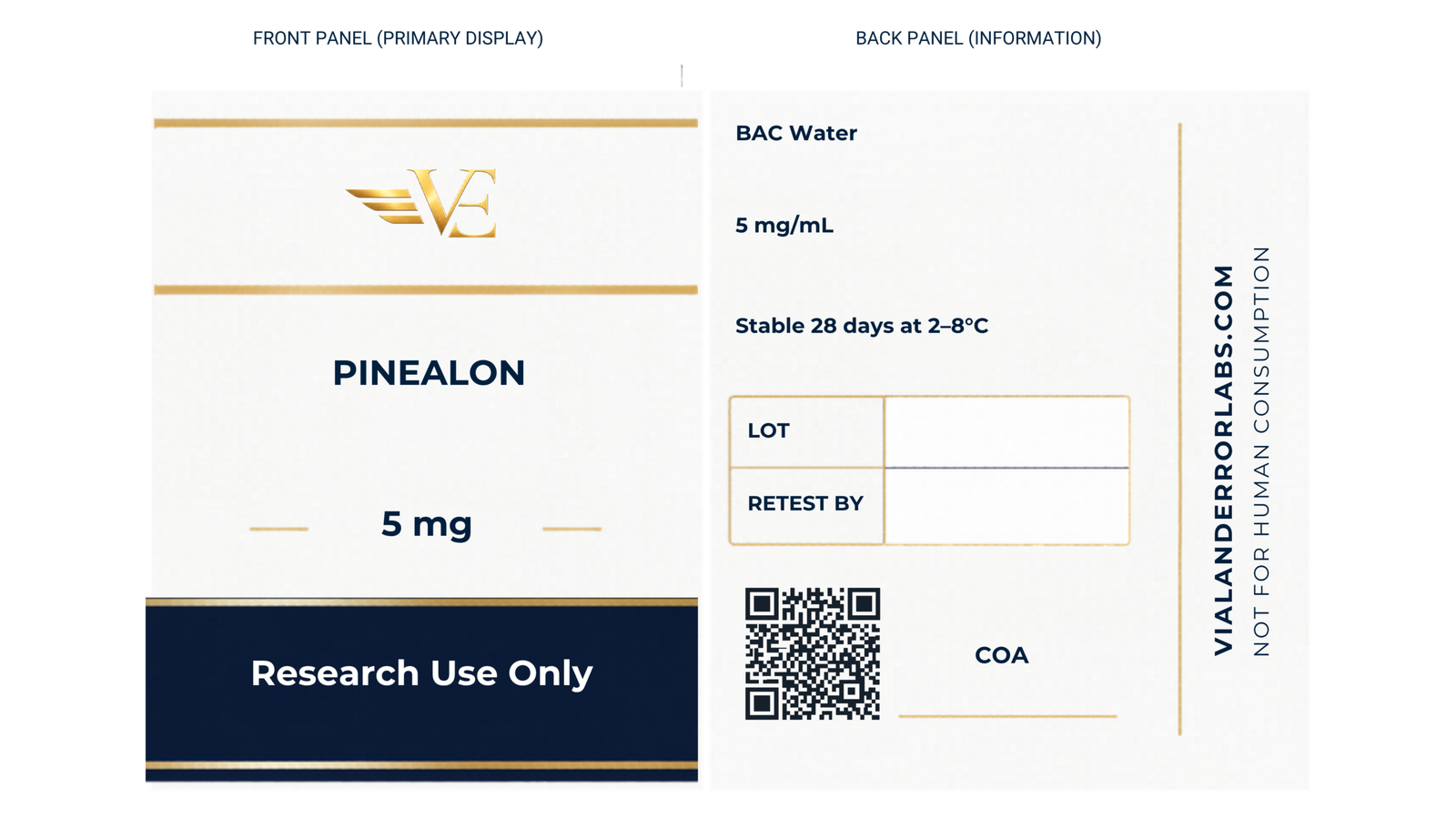
COA: Lot-specific, included with order (QR on label)
Handling & Storage
Storage Temperature: Store desiccated at −20°C for long-term; 2–8°C short-term. Protect from light. Refer to SDS/COA for compound-specific handling.
Light Sensitivity: Protect from light
Moisture: Store desiccated when applicable
Available Strengths: 5 mg · 10 mg · 20 mg
SKU (5 mg): VE-PINE-005
SKU (10 mg): VE-PINE-010
SKU (20 mg): VE-PINE-020
-
-
What is this product?
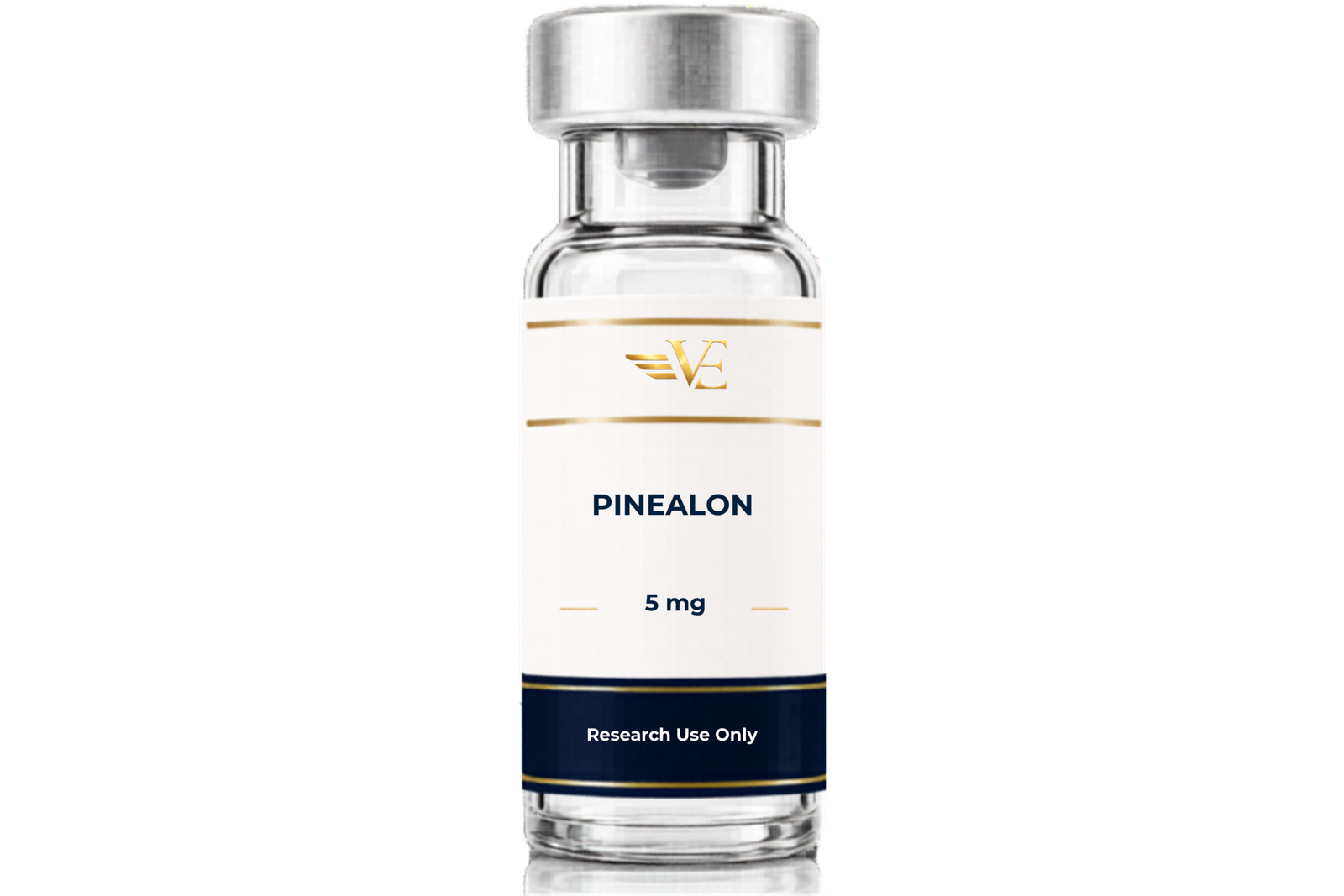
Pinealon (CAS 135558-08-6, MW 354.41 g/mol, C₁₆H₂₆N₄O₅) is a synthetic Glu-Asp-Arg tripeptide from the Khavinson bioregulator series, supplied as a lyophilized powder for laboratory research use only. It is studied in circadian biology and neuroprotection research. Available as VE-PINE-005 (5 mg), VE-PINE-010 (10 mg), and VE-PINE-020 (20 mg).
-
What purity and testing methods are used?
Each lot is tested by reverse-phase HPLC and MS confirmation to ≥98% purity with sequence verification. A lot-specific COA is included with every order, accessible via QR code on the label.
-
What are the key chemical identifiers?
CAS 135558-08-6 · Molecular formula C₁₆H₂₆N₄O₅ · MW 354.41 g/mol · Sequence: Glu-Asp-Arg · Synonyms: EDR, Khavinson pineal peptide, pineal neuroprotective tripeptide, circadian bioregulator peptide.
-
What signaling pathways does Pinealon address in research models?
Pinealon is studied in neural and pineal models for: circadian clock gene expression (BMAL1/CLOCK/PER2/CRY1 regulation), AANAT/HIOMT melatonin synthesis pathway markers, BDNF/TrkB/CREB neuroprotective signaling cascade, Nrf2/HO-1/NQO1 oxidative stress pathway in neurons, and mitochondrial membrane potential maintenance under ischemic/hypoxic challenge.
-
How is Pinealon reconstituted for research use?
Dissolve in sterile water or PBS (pH 7.0) at ~5 mg/mL. Use immediately or aliquot and store at −80°C. Avoid repeated freeze-thaw cycles. Protect from light (the Trp-adjacent signaling context makes light-sensitivity relevant).
-
What is the recommended storage upon receipt?
Store immediately at −20°C desiccated. Short-term at 2–8°C acceptable for up to 2 weeks. Inspect vials for integrity upon receipt.
-
What is a COA and why does it matter?
A COA documents lot-specific purity (HPLC ≥98%), sequence verification (MS: Glu-Asp-Arg confirmed), and appearance. Each Pinealon lot ships with a QR-accessible COA. Review before use to confirm identity and purity meet your experimental requirements.
-
What is this product?
-
PubMed Literature Search — Pinealon
Primary literature · curated search
Open PubMedPubMed Literature Search — Pinealon (Русский)
Includes Cyrillic term: Пинеалон
Open PubMedPubChem Compound Record
Full chemical data, bioassays, patents
View RecordSource Document / Insert
Supplier insert or supporting SDS source
Download PDF