


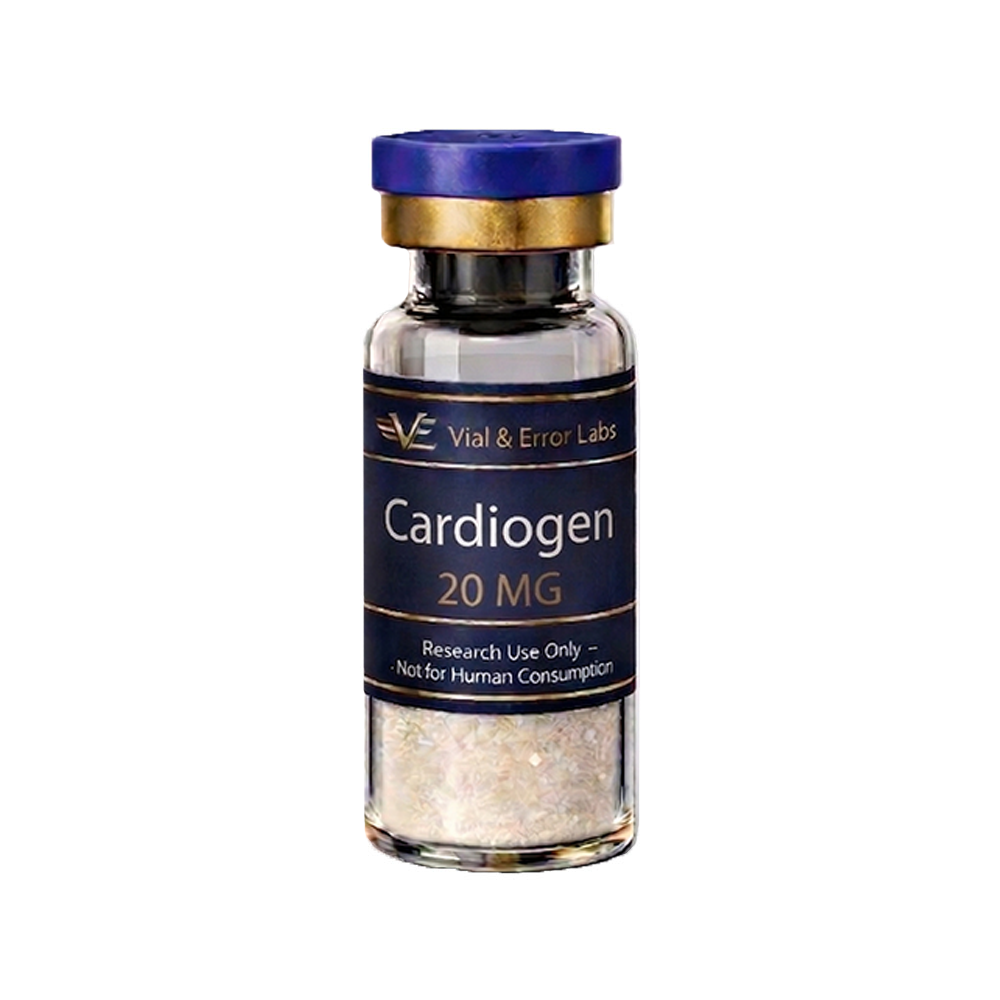
Description
-
About Cardiogen
Cardiogen — a synthetic Ala-Glu-Asp-Arg tetrapeptide (CAS 135537-11-0) from the Khavinson peptide bioregulator series — is a tissue-specific peptide studied as a model cardiac cytoprotective signal in cardiovascular and myocardial research. It is supplied as a laboratory-grade lyophilized powder intended strictly for analytical and non-clinical research applications.
As a member of the short peptide bioregulator family, Cardiogen is investigated for its selectivity toward cardiomyocyte and cardiac tissue signalling models. Researchers use Cardiogen in H9c2 cardiomyoblast, neonatal rat ventricular cardiomyocyte (NRVM), and HL-1 cardiac cell models to examine effects on cell survival pathway activation (Bcl-2/Bax ratio, caspase-3 activity), mitochondrial membrane potential maintenance under stress conditions, and cardiomyocyte-specific gene expression markers under standardised in vitro conditions.
COMMON RESEARCH APPLICATIONS
Cardiomyocyte Cell Survival & Apoptosis Research
Cardiogen is examined in H9c2 and NRVM models under hypoxia/reoxygenation or doxorubicin challenge to study Bcl-2/Bax ratio modulation, caspase-3/7 activity, and mitochondrial membrane potential (ΔΨm) as cytoprotective endpoint markers.Cardiac Inflammation Pathway Screening
Used in cytokine-challenged cardiomyocyte models (IL-1β, TNF-α) to study NF-κB pathway activation, ICAM-1 expression, and anti-inflammatory signalling relative to vehicle and reference cytoprotective compound controls.Mitochondrial Function & Energy Metabolism
Examined in Seahorse XF mitochondrial stress tests using cardiac cell lines to assess oxygen consumption rate (OCR), ATP production rate, and mitochondrial reserve capacity under Cardiogen treatment conditions.Comparative Khavinson Cardiac Bioregulator Studies
Benchmarked alongside related Khavinson tetrapeptides (Bronchogen, Testagen, Thymalin) to characterise tissue selectivity profiles and shared vs. distinct signalling features within the short peptide bioregulator class. -
Chemical Identity
Compound Name: Cardiogen
Synonyms: Ala-Glu-Asp-Arg · Khavinson cardiac peptide · cardiac cytoprotective tetrapeptide
CAS Number: 135537-11-0
EC Number: N/A (synthetic tetrapeptide)
Molecular Formula: C18H31N7O6
Molecular Weight: 441.48 g/mol
Physical Properties
Appearance: White to off-white lyophilized powder
Solubility (water): ~5 mg/mL in sterile water or PBS (pH 7.0)
Solubility (organic): Limited solubility in organic solvents
Hygroscopic: Yes — store desiccated
Quality & Testing
Purity: ≥98% (HPLC)
Testing Method : Reverse-phase HPLC · MS confirmation · sequence verification
Verification
COA: Lot-specific, included with order (QR on label)
SDS Supplier : Velox Research Chemicals
SDS Revision: Current lot · OSHA HCS / GHS compliant
Handling & Storage
Storage Temperature: Store desiccated at −20°C for long-term; 2–8°C short-term. Protect from light. Refer to SDS/COA for compound-specific handling.
Light Sensitivity: Protect from light
Reconstitution: Dissolve in sterile water or PBS (pH 7.0); use immediately or aliquot and store at −80°C
Available Strengths: 20 mg
SKU (20 mg): VE-CARD-020
-
-
What is this product?
Cardiogen (CAS 135537-11-0, MW 441.48 g/mol) is a synthetic Ala-Glu-Asp-Arg tetrapeptide from the Khavinson bioregulator peptide series, supplied as a lyophilized powder for laboratory research use only. It is studied as a model cardiac cytoprotective peptide in cardiomyocyte signalling research.
-
What purity and testing methods are used?
Each lot is tested by reverse-phase HPLC and MS confirmation to ≥98% purity with sequence verification. A lot-specific COA is included with every order, accessible via QR code on the label.
-
What are the key chemical identifiers?
CAS 135537-11-0 · Molecular formula C₁₈H₃₁N₇O₆ · MW 441.48 g/mol · Sequence: Ala-Glu-Asp-Arg · Synonyms: Khavinson cardiac peptide, cardiac cytoprotective tetrapeptide.
-
How is Cardiogen reconstituted for research use?
Dissolve in sterile water or PBS (pH 7.0) at ~5 mg/mL. Use immediately or aliquot and store at −80°C. Avoid repeated freeze-thaw cycles. Protect from light.
-
What is the recommended storage upon receipt?
Store immediately at −20°C desiccated. Short-term at 2–8°C is acceptable for up to 2 weeks. Inspect vials for integrity upon receipt.
-
What is a COA and why does it matter?
A COA documents lot-specific purity (HPLC ≥98%), sequence verification (MS), and appearance. Each lot ships with a QR-accessible COA. Review before use to confirm identity and purity meet your experimental requirements.
-
What is this product?
Reviews
There are no reviews yet.