

Description
-
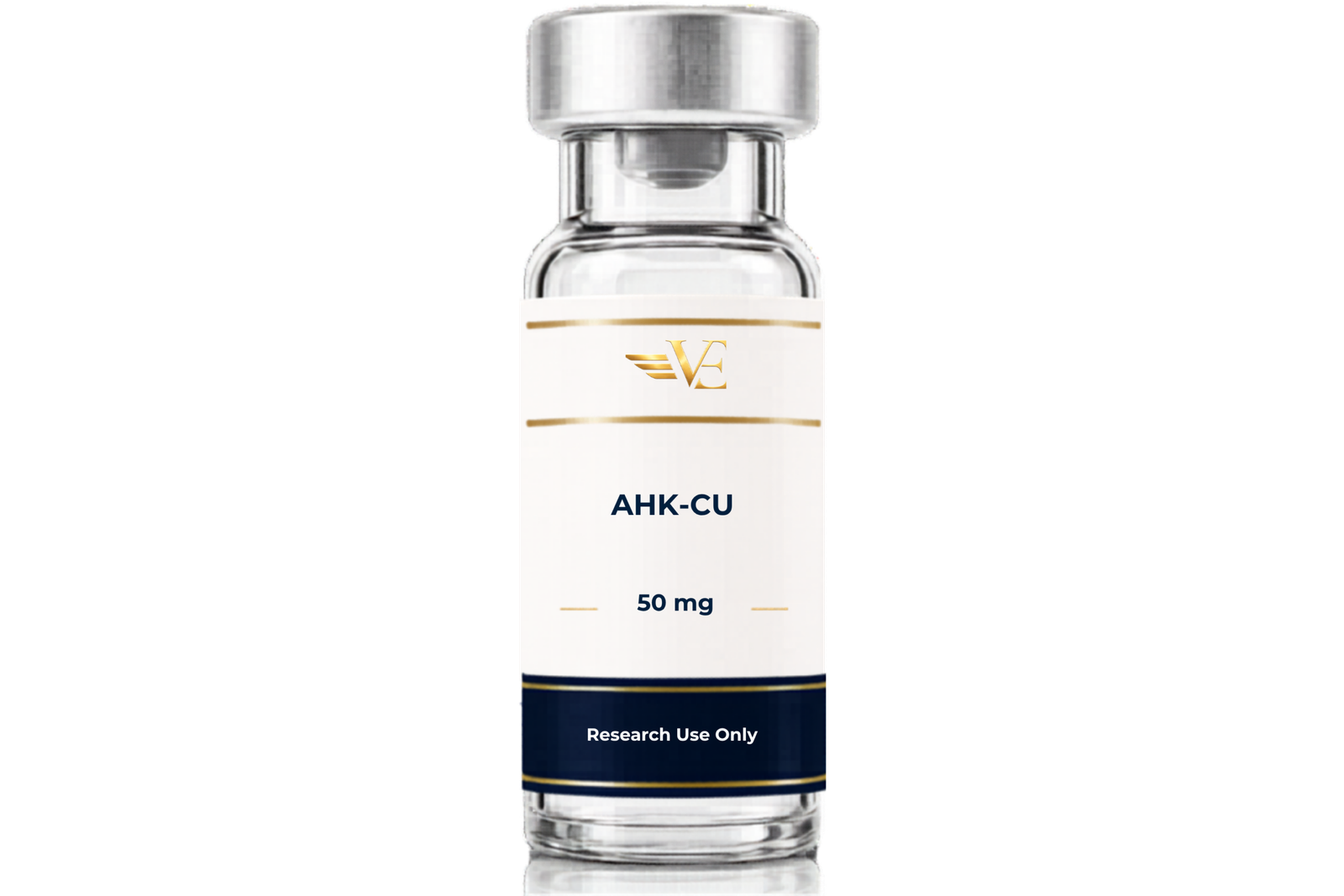
AHK-CU
AHK-CU — Ala-His-Lys chelated to copper(II) (CAS 145438-82-0) — is a synthetic copper–tripeptide complex studied as a model scaffold for copper-dependent biological signaling in skin biology and extracellular matrix (ECM) research. It is supplied as a laboratory-grade lyophilized powder intended strictly for analytical and non-clinical research applications.
Copper(II) coordination via the histidine imidazole and terminal amine of the AHK tripeptide confers the complex with distinct redox and metallopeptide properties compared to the non-chelated GHK sequence. Researchers use AHK-CU in fibroblast and keratinocyte in vitro models to examine copper-dependent collagen synthesis pathway activation, SOD-mimetic oxidative stress responses, and ECM remodeling assays where copper bioavailability is a controlled variable.
COMMON RESEARCH APPLICATIONS
Collagen Synthesis Pathway Research
AHK-CU is used in dermal fibroblast models to study copper-dependent stimulation of collagen I and III gene expression, pro-collagen processing enzyme activity (LOX, PAD), and ECM matrix deposition assays.Oxidative Stress & SOD-Mimetic Assays
The copper chelate is examined in H₂O₂ challenge and ROS detection models in keratinocytes to assess copper-mediated antioxidant pathway modulation and SOD-like radical scavenging activity.ECM Remodeling Studies
Used in scratch assay and fibroblast contraction models to study AHK-CU effects on MMP/TIMP balance, fibronectin deposition, and integrin-mediated signaling in wound-environment matrices.Comparative Copper-Peptide Screening
Benchmarked alongside GHK-Cu and other copper-chelated peptides to characterize structure-activity relationships in copper coordination geometry and downstream ECM pathway selectivity. -
Chemical Identity
Compound Name: AHK-CU
Synonyms: Ala-His-Lys copper(II) · Copper tripeptide AHK · Cu-AHK · glycyl-histidyl-lysine copper analogue
CAS Number: 145438-82-0
EC Number: N/A (synthetic copper–tripeptide complex)
Molecular Formula: C14H22CuN6O4
Molecular Weight: 397.88 g/mol
Physical Properties
Appearance: Blue-green lyophilized powder
Solubility (water): ~5 mg/mL in sterile water or PBS (pH 7.0)
Solubility (organic): Limited; slight DMSO solubility
Hygroscopic: Yes — store desiccated
Quality & Testing
Purity: Reverse-phase HPLC · MS confirmation · ICP copper verification
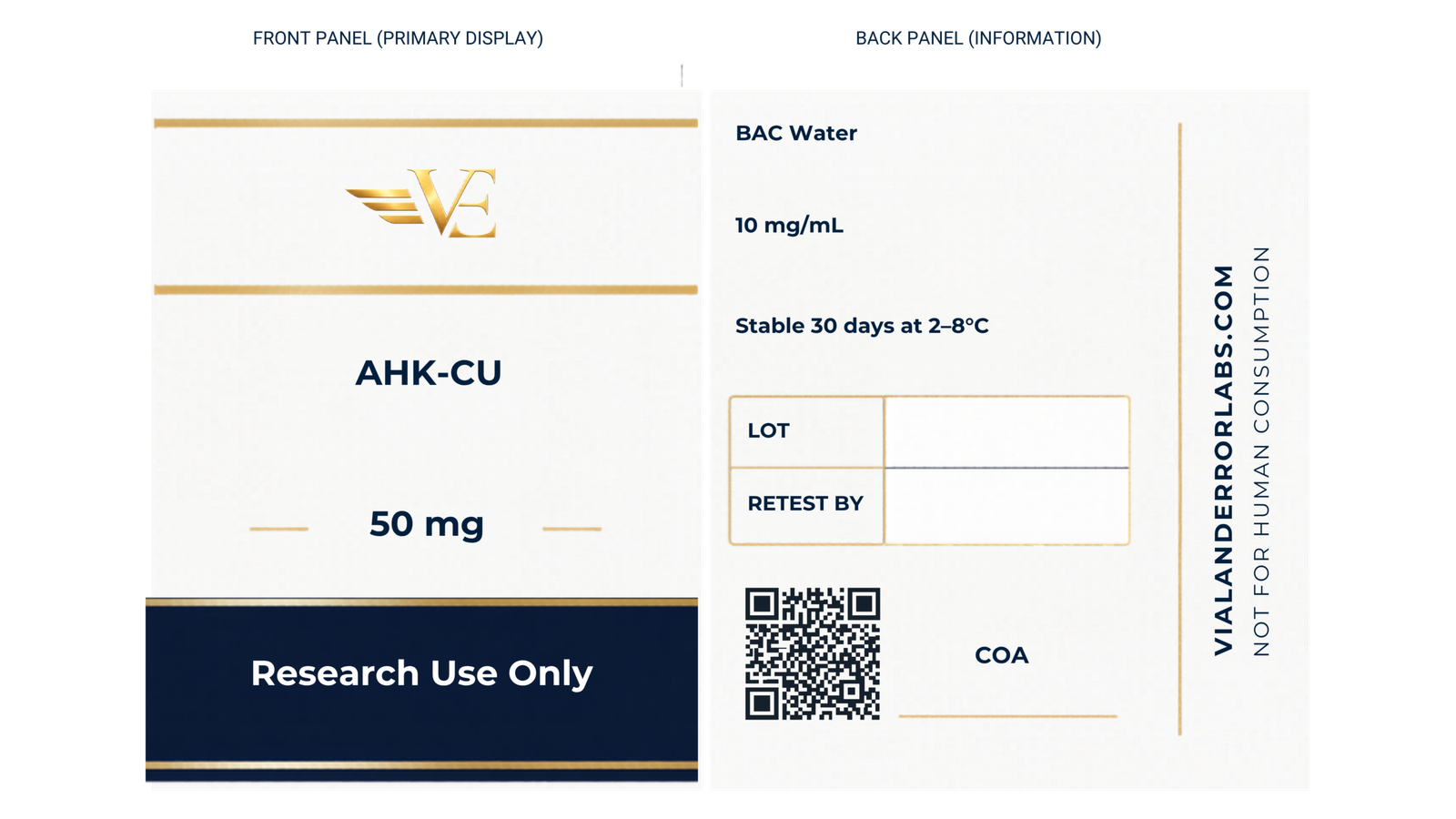
Testing Method : Lot-specific, included with order (QR on label)
Verification
COA: Lot-specific, included with order (QR on label)
SDS Revision: Current lot · OSHA HCS / GHS compliant
Handling & Storage
Storage Temperatur: Store desiccated at −20°C for long-term; 2–8°C short-term. Protect from light. Refer to SDS/COA for compound-specific handling
Light Sensitivity: Protect from light
Reconstitution: Dissolve in sterile water or PBS (pH 7.0) at ~5 mg/mL; use immediately or aliquot at −80°C
Available Strengths: 50 mg
-
-
What is this product?
AHK-CU (CAS 145438-82-0, MW 397.88 g/mol) is a synthetic copper(II)–tripeptide complex (Ala-His-Lys) supplied as a lyophilized blue-green powder for laboratory research use only. It serves as a model copper-peptide tool compound for ECM and skin biology signaling research.
-
What purity and testing methods are used?
Each lot is tested by reverse-phase HPLC to ≥98% purity, with MS confirmation of peptide identity and ICP analysis to verify copper stoichiometry. A lot-specific COA is included with every order, accessible via QR code on the label.
-
What are the key chemical identifiers?
CAS 145438-82-0 · Molecular formula C₁₄H₂₂CuN₆O₄ · MW 397.88 g/mol · Synonyms: Ala-His-Lys copper(II), Copper tripeptide AHK, Cu-AHK.
-
What signaling pathways does AHK-CU address in research models?
AHK-CU is studied in collagen synthesis pathway models (LOX, PAD enzyme activity), oxidative stress response assays (copper-mediated SOD-mimetic activity), and ECM remodeling research (MMP/TIMP balance). It is examined in fibroblast and keratinocyte cell lines as a model for copper–peptide ECM interactions.
-
How is AHK-CU reconstituted for research use?
Dissolve in sterile water or PBS (pH 7.0) at ~5 mg/mL. Use immediately or aliquot and store at −80°C. Avoid repeated freeze-thaw cycles and protect from light to prevent copper-peptide complex degradation.
-
What is the recommended storage upon receipt?
Store immediately at −20°C desiccated. Short-term at 2–8°C is acceptable for up to 2 weeks. The copper chelate is sensitive to moisture and light; inspect vials for colour integrity (blue-green) upon receipt.
-
What is a COA and why does it matter?
A COA documents lot-specific purity (HPLC ≥98%), peptide identity (MS), copper content (ICP), and appearance. Each lot ships with a QR-accessible COA. Review before use to confirm identity, purity, and copper stoichiometry meet your experimental requirements.
-
What is this product?
-
PubMed Literature Search — AHK-CU
Primary literature · curated search
Open PubMedPubChem Compound Record Full chemical data, bioassays, patents
View RecordSource Document / Insert
Supplier insert or supporting SDS source
Download PDF